


In a recent article on how the NBA divides its minutes, I emphasized that regular season minutes were being spread across more players, while playoff rotations remained much tighter. Making a deep playoff run could add another third of a season to an individual player’s workload.
The investigation into NBA minutes led me to another question. Is the game becoming so demanding that it’s pushing out older NBA players?
To work through that question, I looked at the past 27 seasons of playing time and production, then compared them with pace and movement.1
Is the NBA getting younger?
Let’s start with the players on the court. Instead, of simply averaging roster ages, I weighted each player’s age by his regular-season minutes.
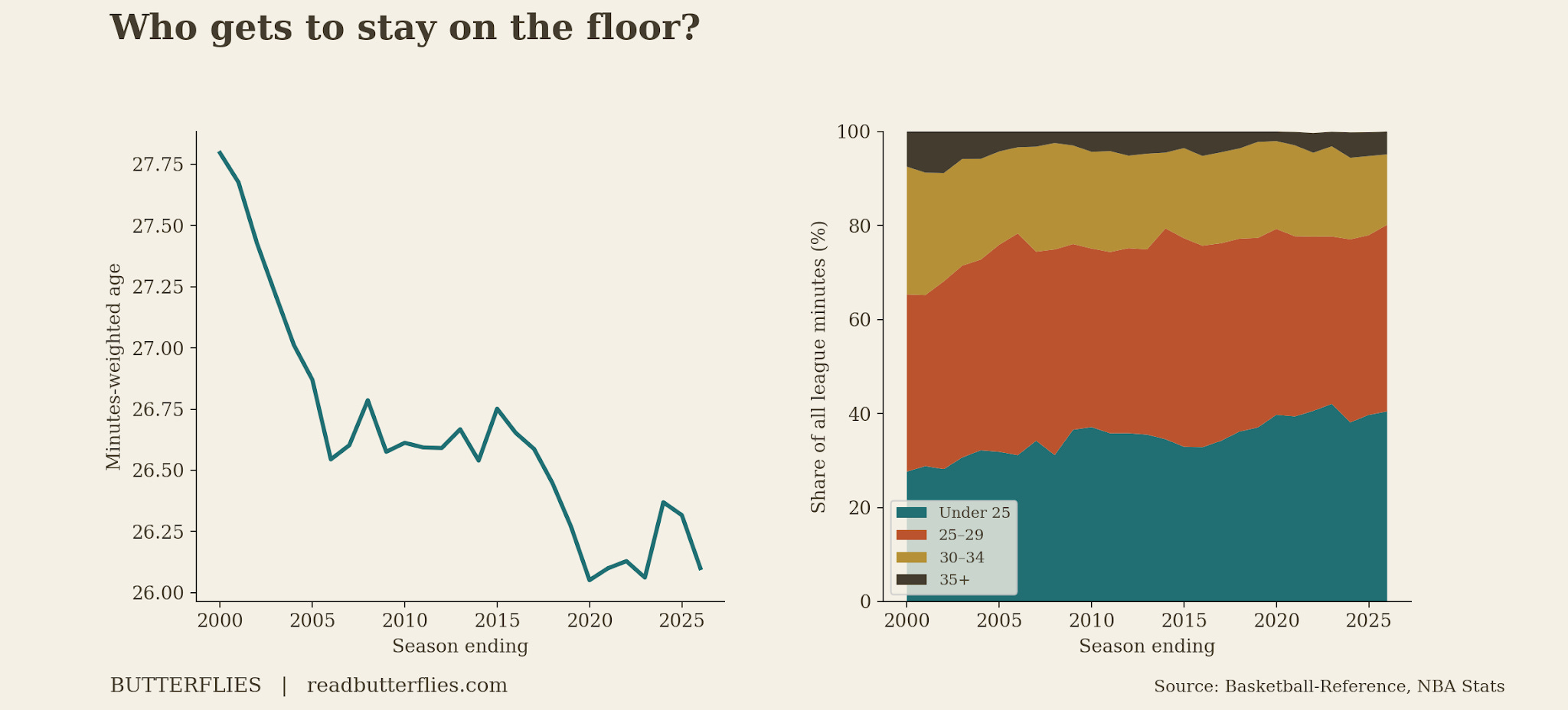
The NBA went from a minutes-weighted average age of 27.8 in 1999/00 to 26.1 in 2025/26. Players younger than 25 increased their share of minutes from 27.6% to 40.5%.
The biggest change at the older end was among players aged 30 to 34. Their share fell from 27.2% to 14.9%. Players aged 35 and older also saw a decline in minutes, from 7.5% to 4.9%.
The timing is also interesting here. By 2009/10, minutes-weighted age had already fallen to 26.6. About 70% of the decline since 1999/00 had already happened before the later acceleration in pace in the mid 2010s. We’ll get to that in a bit.
Where is the production coming from?
I also wanted to know whether the league’s production was moving to a younger cohort of players. I look at points, rebounds, and assists. All three have shifted to younger players since 1999/00. The scoring-weighted age fell from 27.5 to 26.3, rebounding from 27.7 to 26.0, and assists from 27.9 to 26.3.
Players under 30 now provide about 79% of points, rebounds, and assists. In 1999/00, they accounted for 67.7% of points, 65.2% of rebounds, and 64.4% of assists. All of this makes sense given the shift in playing time to younger players.
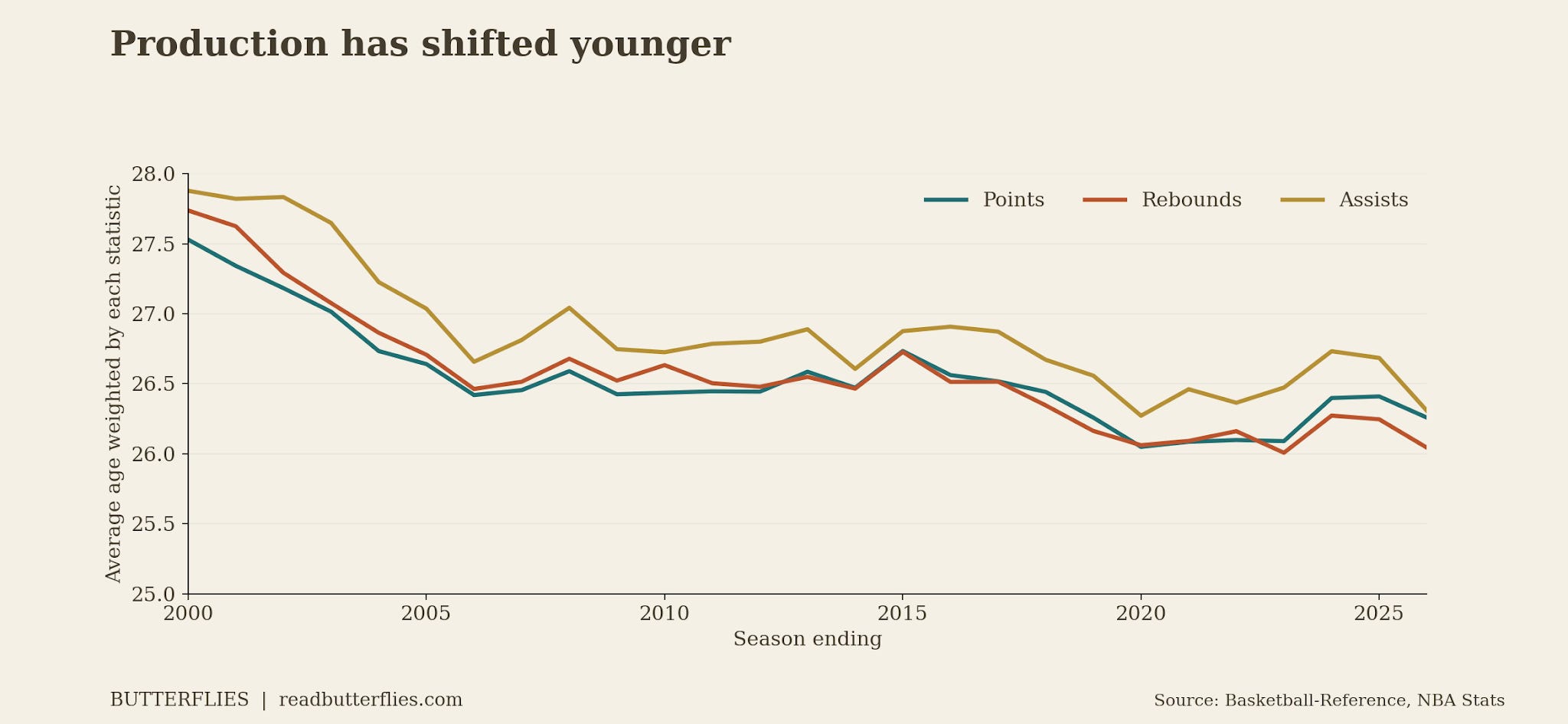
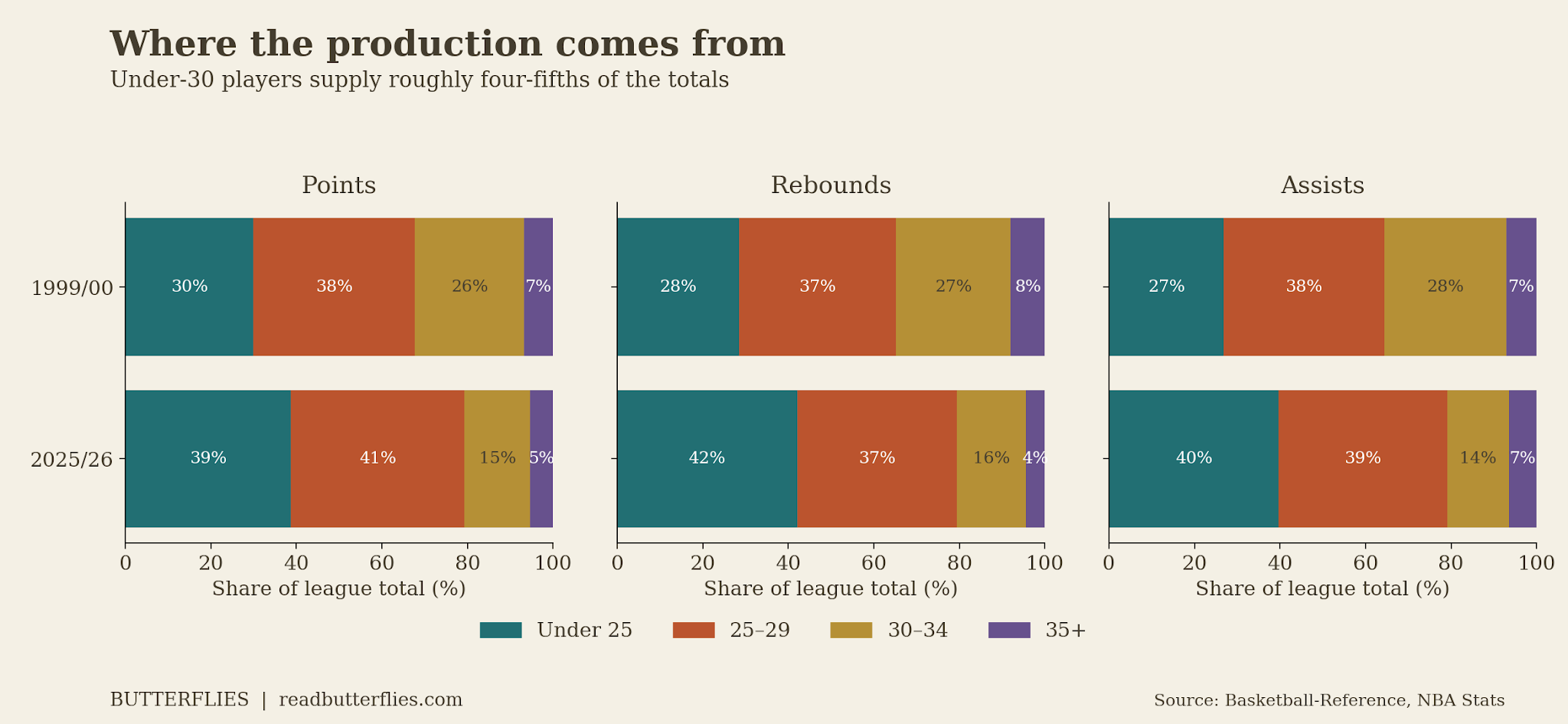
So with that, we have evidence that the NBA is getting younger and production is shifting to younger players. This still doesn’t mean that the game isn’t well suited for older players now, but it does show that a shift is happening.
Let’s dive into some potential theories about why the game is getting younger.
Are there too many minutes in a season for older legs?
To set the scene, let’s discuss how many minutes are in a season.
Every team gets 240 player-minutes to distribute in a regulation game. Across an 82-game season, that’s 19,680 minutes before overtime. But are players playing more than they used to and getting burnt out?
Across the regular season, the answer is pretty clearly no.
In 1999/00, the 30 players with the most minutes averaged 3,051 each. Last season, that average was 2,567. That’s a decline of about 16%, or about 16 fewer games if someone played 30 minutes a game.
Players playing lots of minutes has declined. Fourteen players reached 3,000 minutes in 1999/00 and no players reached that threshold last season. Even the 2,500-minute threshold went from 62 players in 1999/00 to 20 players 2025/26.
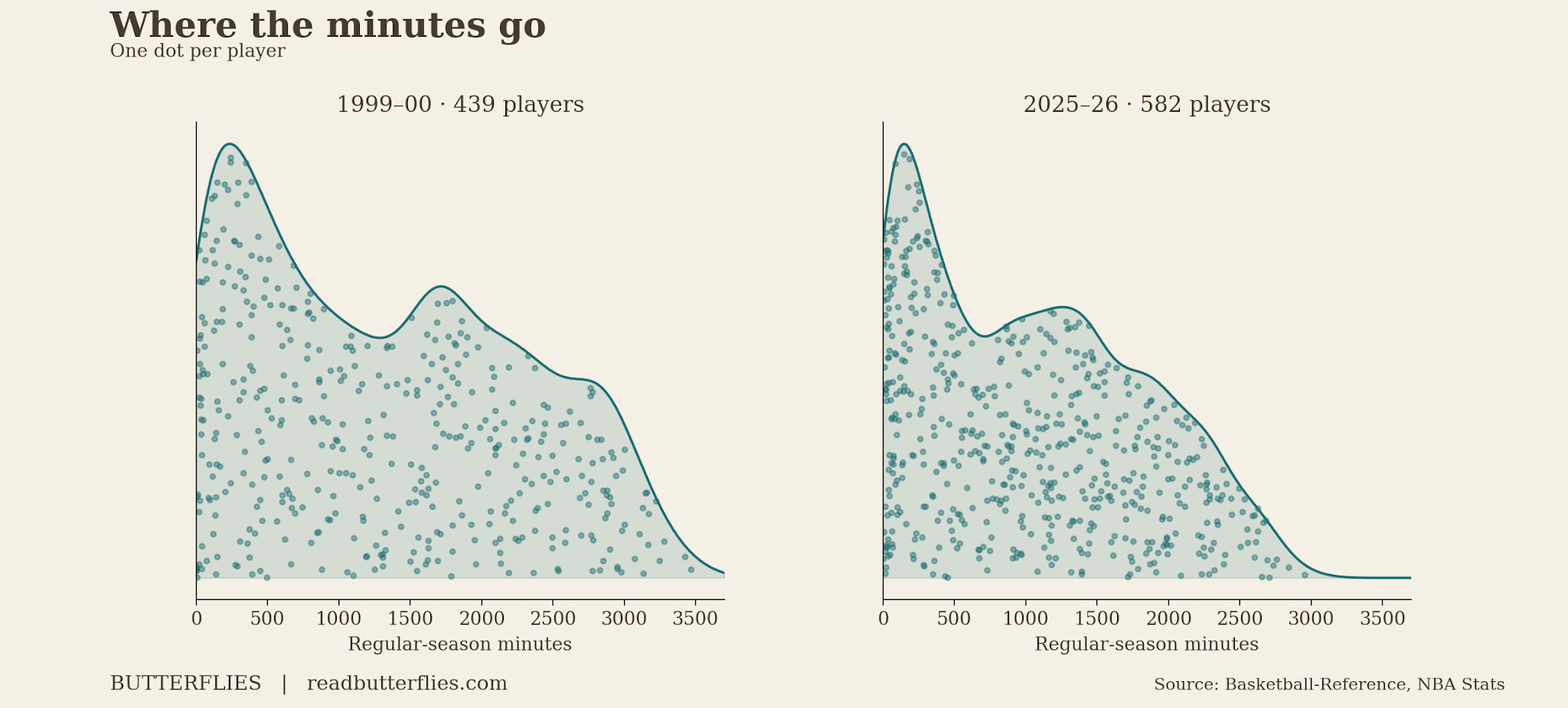
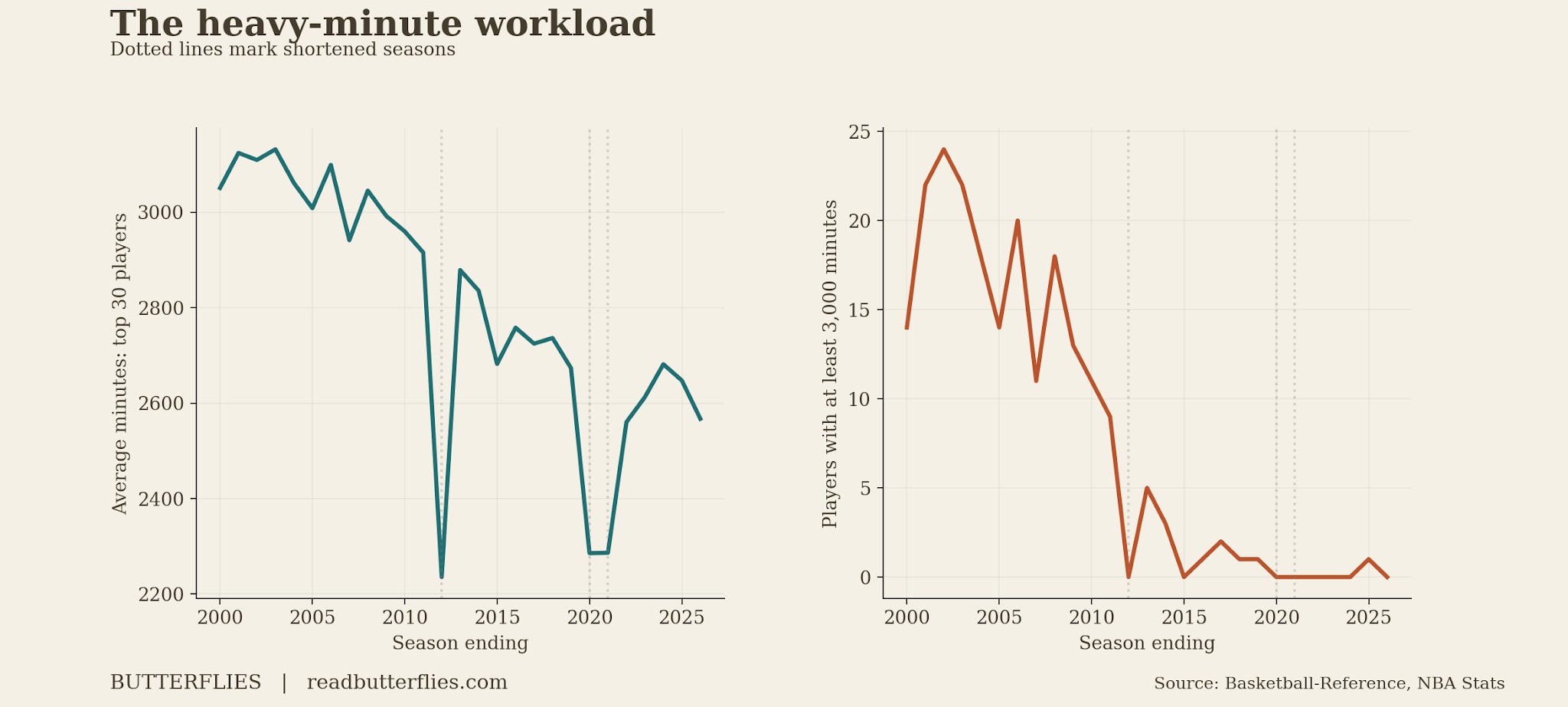
Based on these numbers, a simple explanation of players being worn down because of more minutes doesn’t check out. But if the game’s demands are helping push older players out, something about those minutes would have to explain more of the story.
Is today’s game faster and requiring more exertion?
There are a couple ways we can measure the speed of the game: pace and tracked distance.
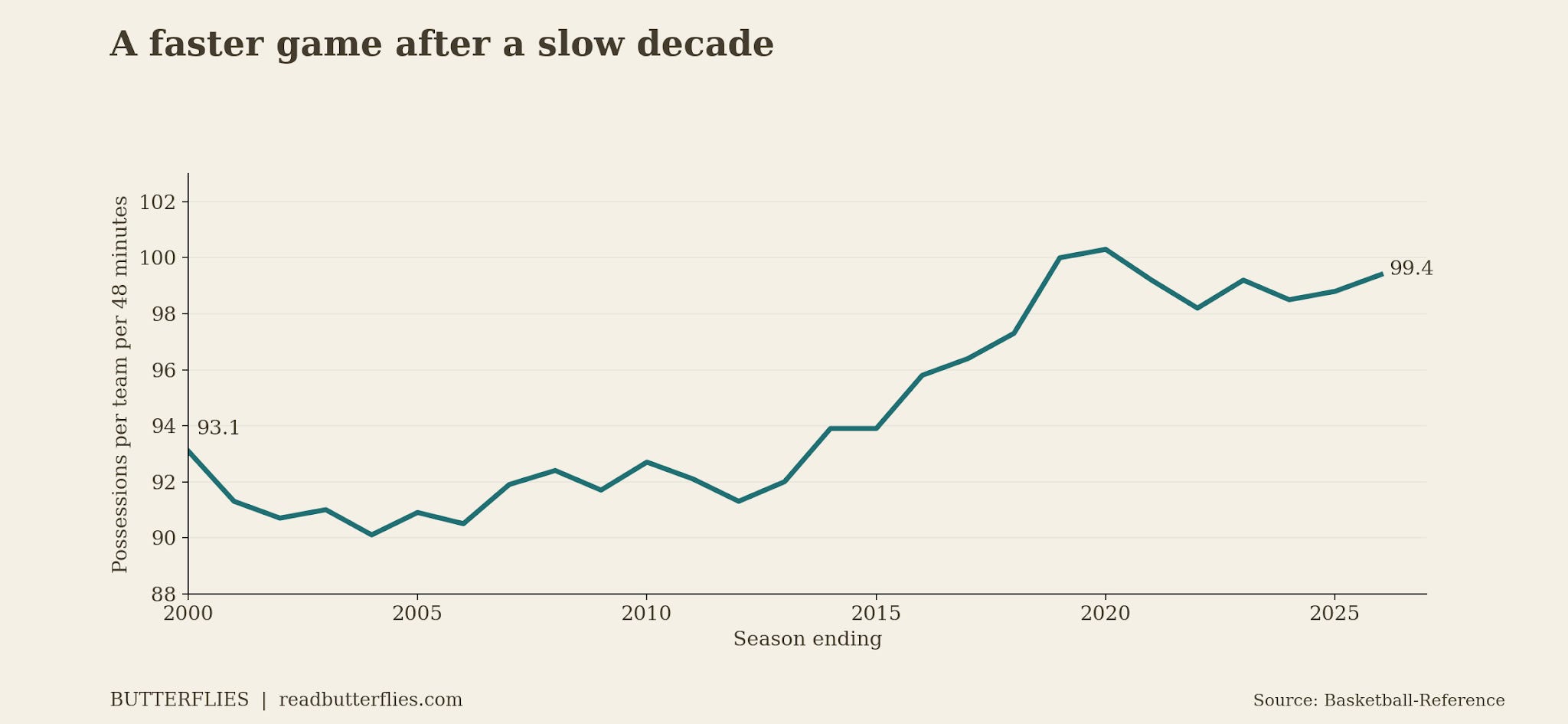
Pace was 93.1 in 1999/00, fell to 90.1 in 2003/04, and was still only 92.7 in 2009/10. The sustained acceleration came later in the 2010s. Last season’s 99.4 possessions per 48 minutes was about 7% above 2000, but below the 100.3 reached in 2019/20.
Over the years, the NBA moved the three-point arc back, allowed zone defense, and cracked down on hand-checking. These changes have likely shaped how offenses space the floor and how defenses cover it today, thanks in large part to the analytics movement. Rules changes are a likely contributor to the pace increases in the mid 2010s.
But the order of events also makes me wonder if part of the story runs the other way. About 70% of the decline in minutes-weighted age had already happened by 2009/10, while pace was still slightly below its 1999/00 level. Perhaps younger lineups also contributed to teams playing faster in the years that followed. It’s not far-fetched to think that age had an impact on pace rather than pace impacting age.
But I don’t think pace gives us everything we need to know. For one, the pace in the 70s was higher than it is today. We also need to observe the movement that occurs on each possession.
Tracked distance rose from 16.9 miles per team each game in 2013/14 to about 18 miles per team by 2018/19. It has hovered near that level since.
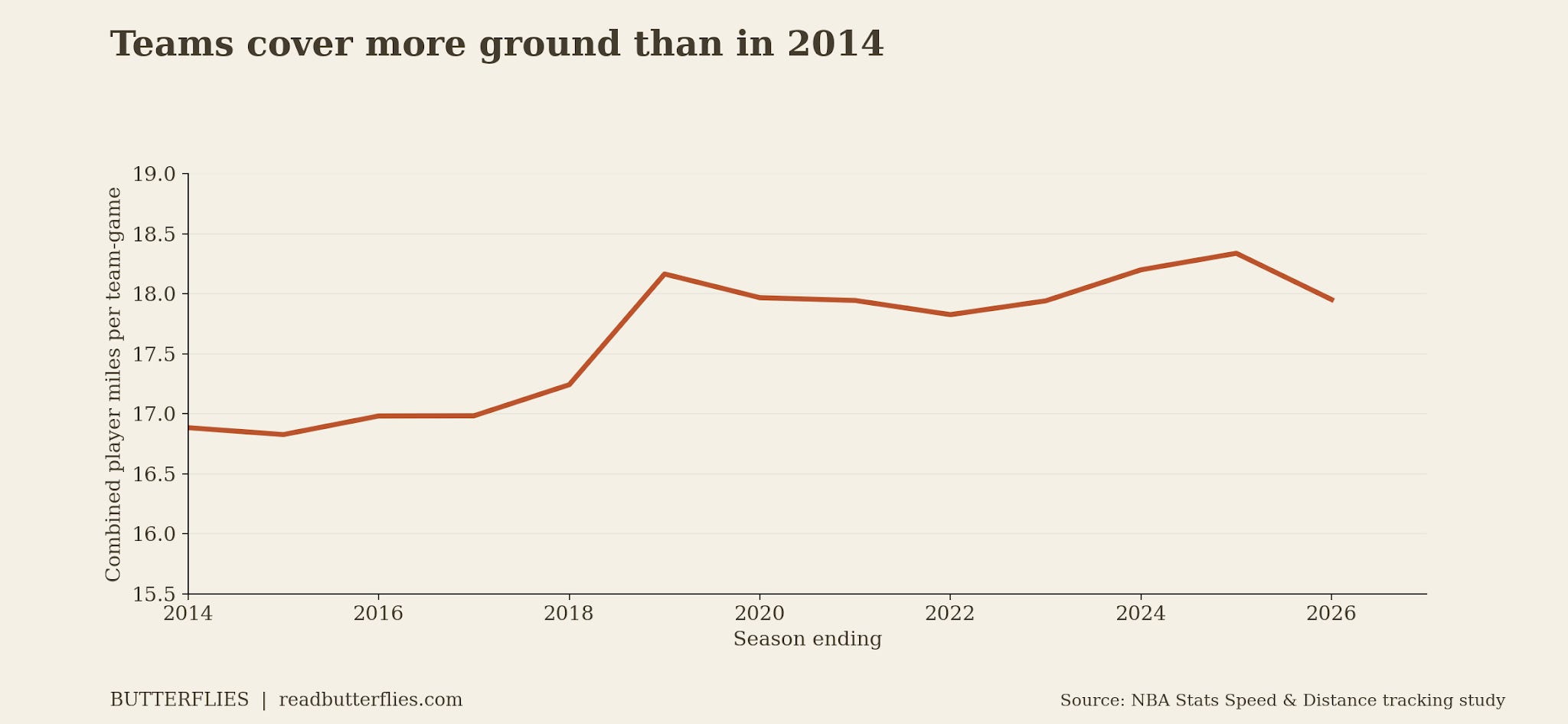
What is harder to measure is the level of exertion a body is going through on the court. Distance traveled doesn’t tell us how hard a player stopped, changed direction, or absorbed contact.
With that said, a simple eye test will reveal the difference in physical exertion from the early 2000s to today. The movement of the game was just slower back then. Play sets evolved around throwing the ball down into the block and playing the game inside the three-point line. The game has extended far beyond the three-point line today, which can ask players to cover more ground as they cut and change direction.
Just look at the highlights of Game 1 of the 2000 NBA Finals. And these are legends! Shaq, Kobe, Reggie. But it’s clear the game was played differently. They may have gotten one or two more fat lips than today’s players, but their legs and muscles probably weren’t as worn down.
So is the game becoming too demanding for older players?
The NBA is younger than it was in 2000. Older players account for less playing time and less of the league’s production. Though the league’s most played players log fewer regular-season minutes than they did in the early 2000s, think about the strain their bodies go through each game. Just defending requires helping at the rim, sprinting back out to the corner to cover a shooter, and then sliding over to cut off a drive.
When you have that much ground to cover, losing half a step as you age can turn a contested shot into an open three. Rule and the analytics movement probably helped shape a game that asks defenders to cover more ground. And a league that was already getting younger may have helped push the pace to where it is now. And all of this likely explains, at least partially, the reduction in minutes a player plays now compared to 20+ years ago.
As the saying goes, Father Time always wins, and it might just be winning sooner rather than later for most in the NBA.