


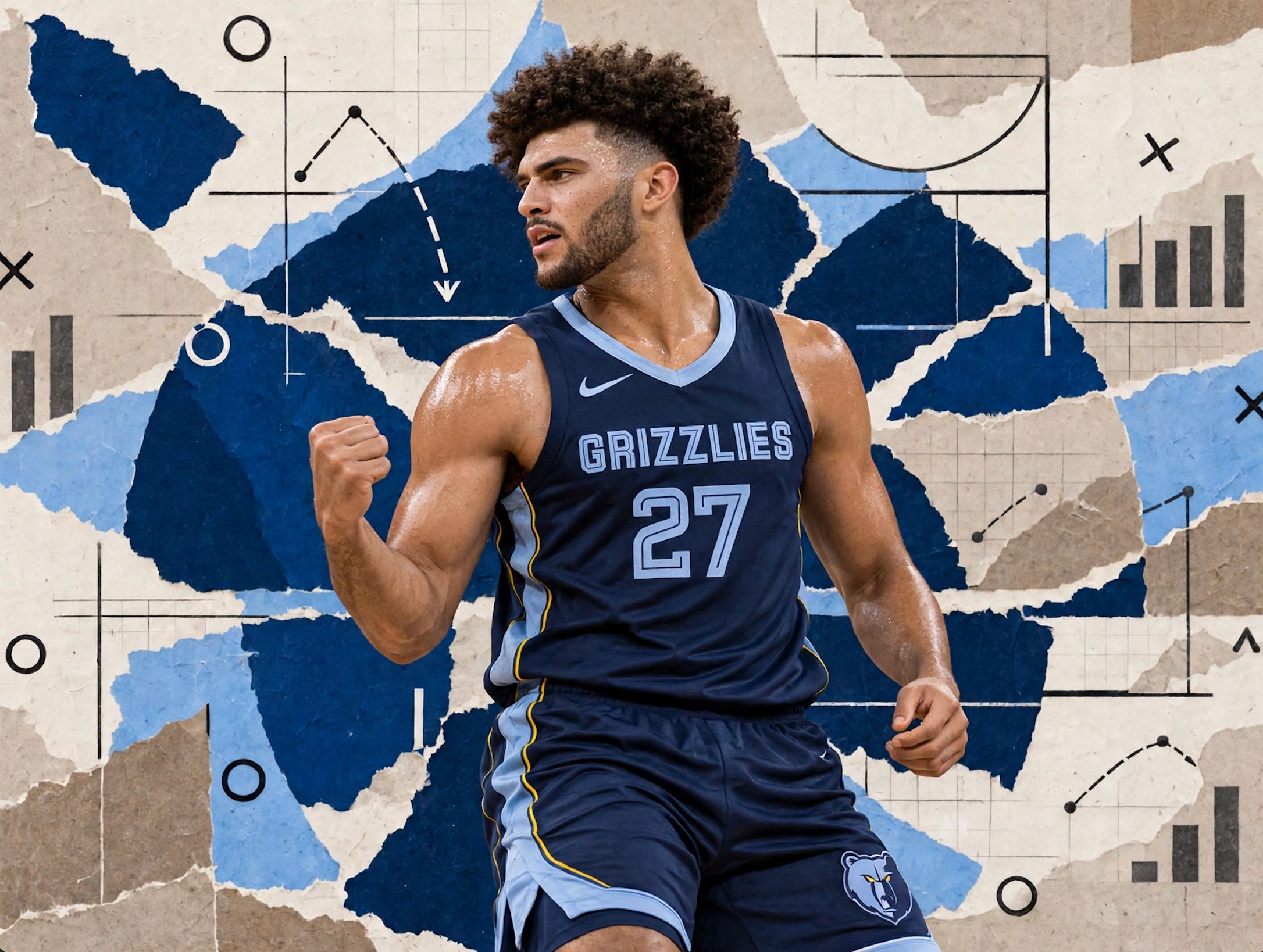
Every season feels like a new crop of rookies is ready to take the NBA by storm. Cooper Flagg, Victor Wembanyama, Paolo Banchero, Stephon Castle, and Cameron Boozer are just a few. Boozer just had a triple-double against my Blazers, so it’s fresh on my mind.
It made me wonder whether the best rookies are contributing more immediately than they used to. Players seem to arrive with more skill, more range, and fewer limitations. They aren’t getting sped up as often as you’d imagine. But are they actually having a bigger impact?
I looked at every season over the last 25 years to find out.
I explored a few different methodologies, but ultimately focused primarily on All-Rookie First and Second Team selections. Those are the rookies that stand out on the TV screen and give us the impression that rookies are more impactful, anyway.
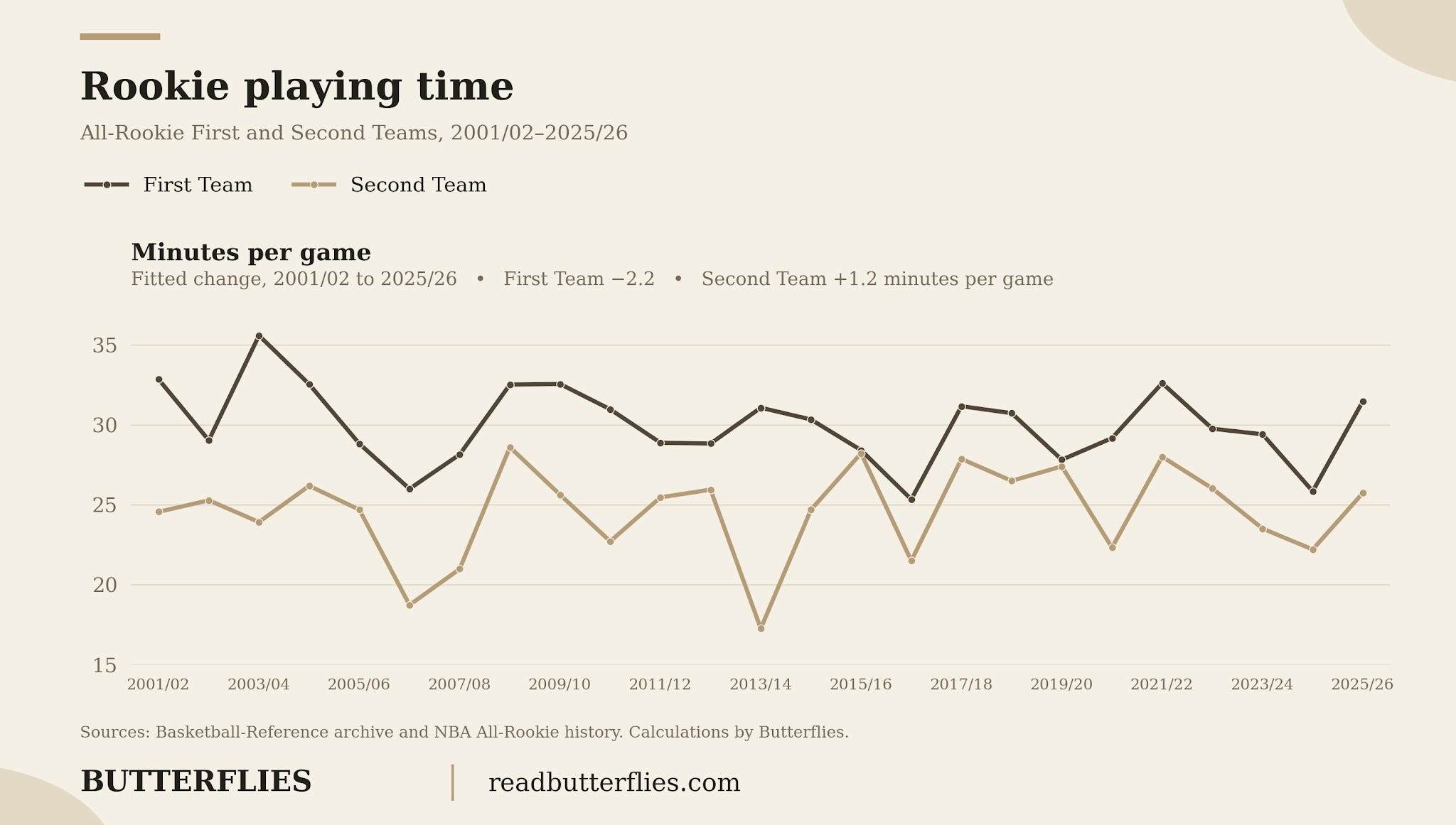
Are rookies getting more minutes?
In short, not really. As you can see from the graph, most first- and second-team selection minutes stay pretty consistent over the last 25 years. This makes it difficult to argue that the best rookies are consistently being handed larger roles. So if rookies are contributing more, it’s not going to be because they are playing more minutes now than in the past.
Are rookies scoring more points?
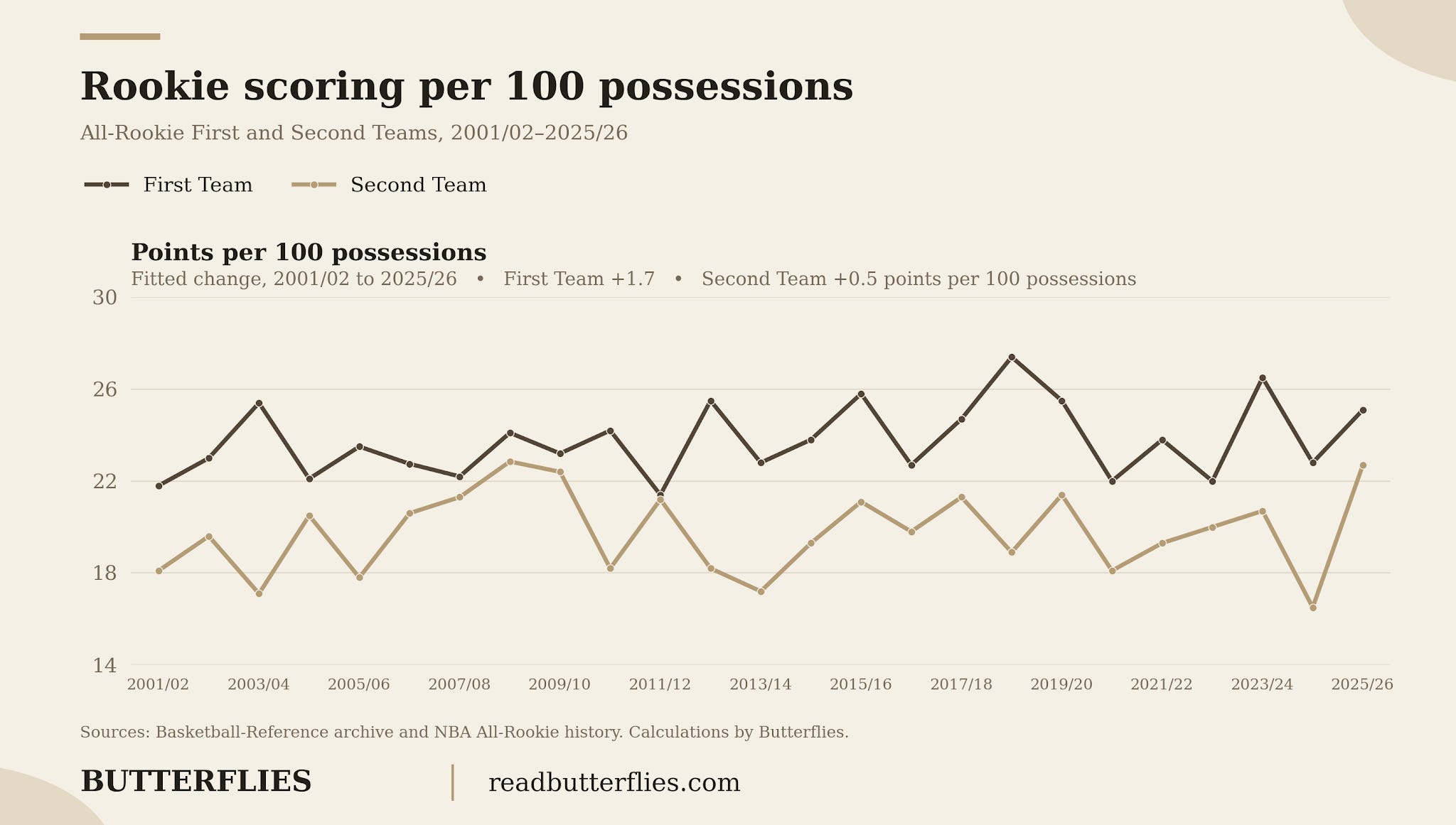
To compare scoring across seasons, I looked at points per 100 possessions. This accounts for differences in the pace of the game and how much time each player spends on the court.
First Team scoring trends upward if you squint a little, although the increase is extremely modest. The Second Team trend is much flatter. Overall, scoring is pretty flat across the board for rookie classes over the last 25 years.
Are rookies shooting more efficiently?
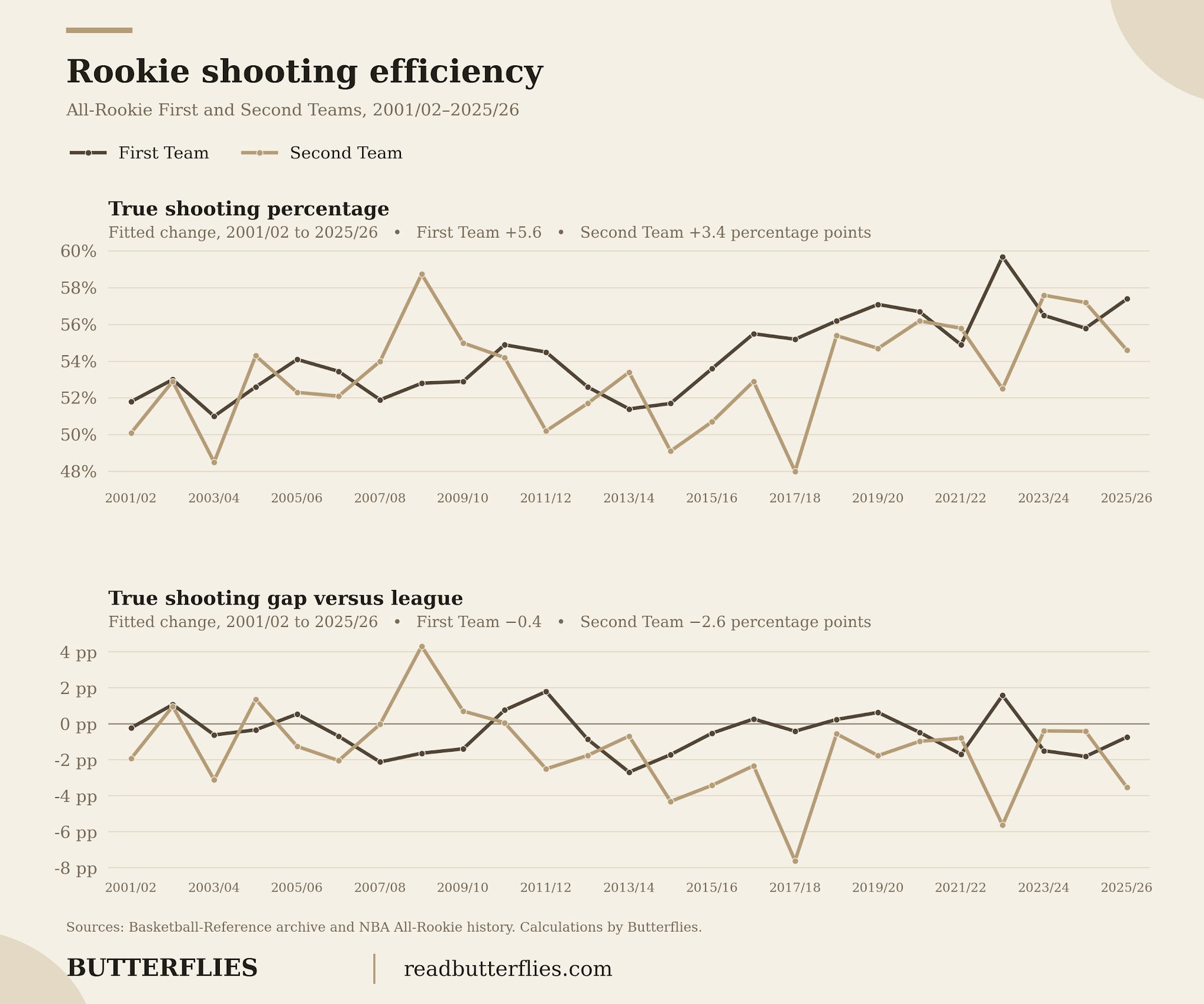
True shooting percentage combines two-pointers, three-pointers, and free throws. True shooting generally improves for both All-Rookie teams across the 25 seasons. But comparing each rookie with the league’s true shooting percentage changes the picture.
The First Team’s efficiency gap is roughly flat to slightly worse over time. The Second Team’s trends downward. Its median falls below the league’s true shooting percentage in 20 of the 25 seasons. Rookies are becoming better shooters while still struggling to keep up with the standard around them.
Are rookies more impactful?
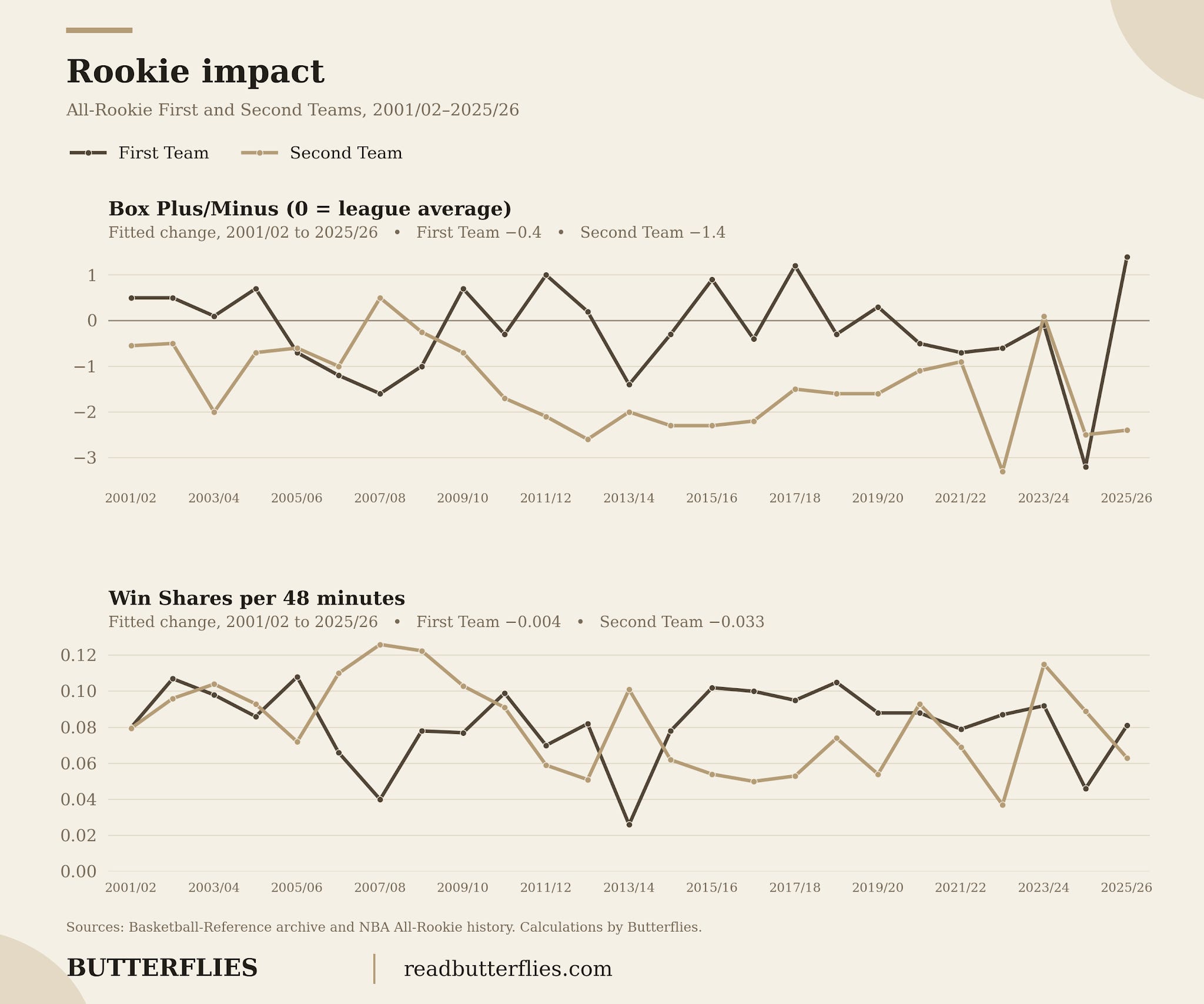
I’ve used Box Plus/Minus (BPM) and Win Shares per 48 minutes (WS/48) before in my article on NBA talent depth. Neither captures everything a player does, but both give us another way to examine performance beyond your typical stats.

BPM estimates a player’s contribution relative to the league using box score statistics. Zero represents league-average performance. It helps us ask how rookies compare with the players they’re competing against each season.
WS/48 is a metric that divides the credit for team success to individual players. It is an estimate of the number of wins contributed by a player per 48 minutes. It considers the output offensively and defensively of a player, adjusted for the pace of the league and team, and the scoring rate of players in the league.
For BPM, the First Team line moves above and below zero throughout the 25 seasons. Its median falls to −3.2 in 2024/25, then rises to +1.4 in 2025/26. Those are the lowest and highest First Team medians in the entire 25 year period, and they happened in consecutive seasons. The Second Team spends much more time below zero, and its overall BPM trend points downward over the 25 seasons. For WS/48, both the First and Second All-Rookie teams are essentially flat.
Are rookies playing more in the playoffs?
For this, it made more sense to look at all rookies since not all who earn All-Rookie honors make the playoffs. Additionally, a rookie can earn playoff minutes without making either All-Rookie team.
I looked at the share of all NBA playoff minutes allocated to rookies in each season. Every rookie who appeared in the playoffs is included, with no minimum playing time. Play-in games are excluded.
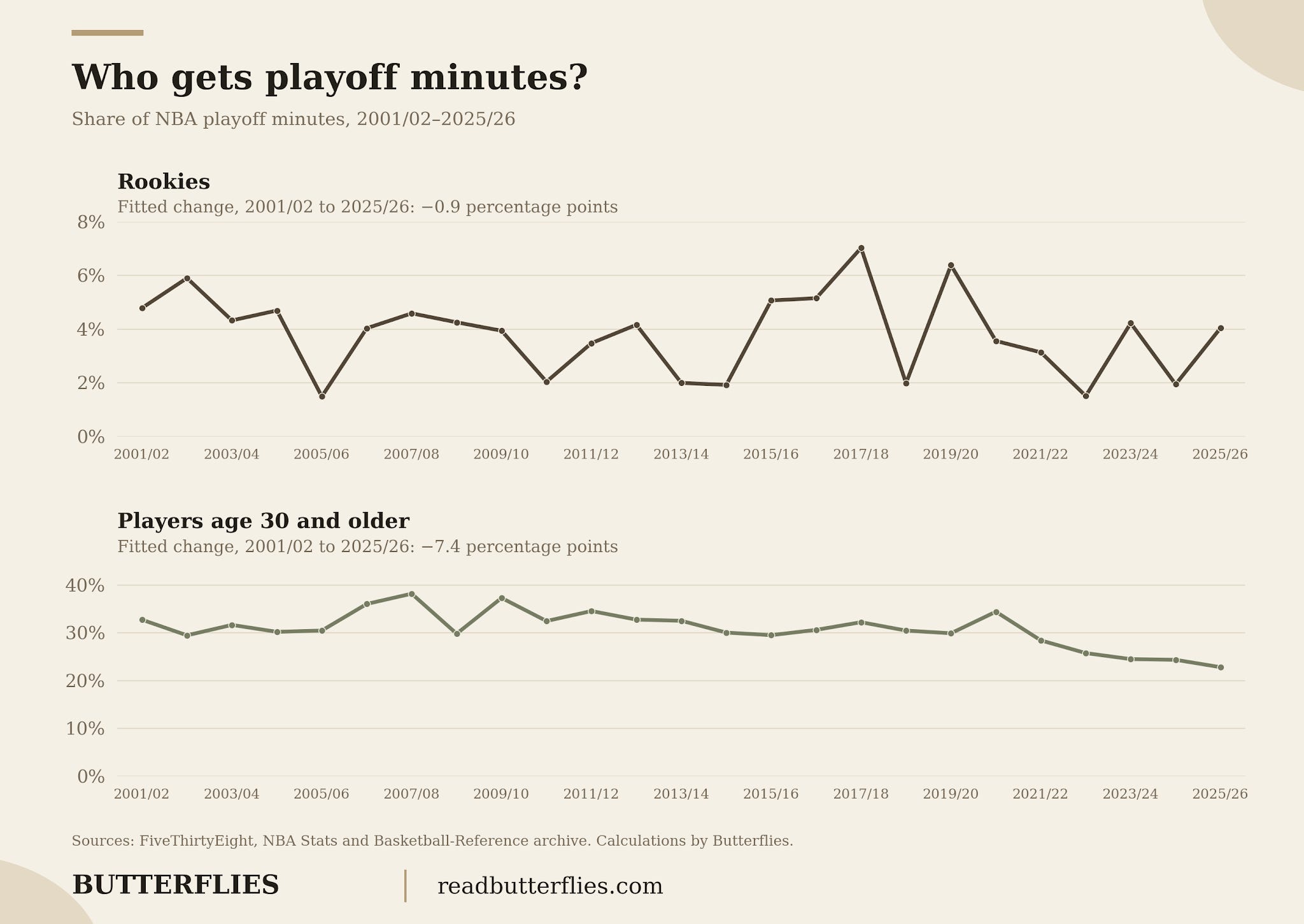
There are big contributions in individual years, but the fitted trend across all 25 seasons edges down by about one percentage point. That broader view doesn’t support the idea that rookies are consistently playing more of the postseason.
I also looked at the other end of the age spectrum. Players aged 30 and older logged about a third of playoff minutes in 2001/02 and just under 23% in 2025/26. They were below 26% in each of the last four seasons. The rookies’ minutes have stayed fairly flat, so the decline in older players’ minutes leaves more minutes for everyone else in between.
What about Rookie of the Year winners?
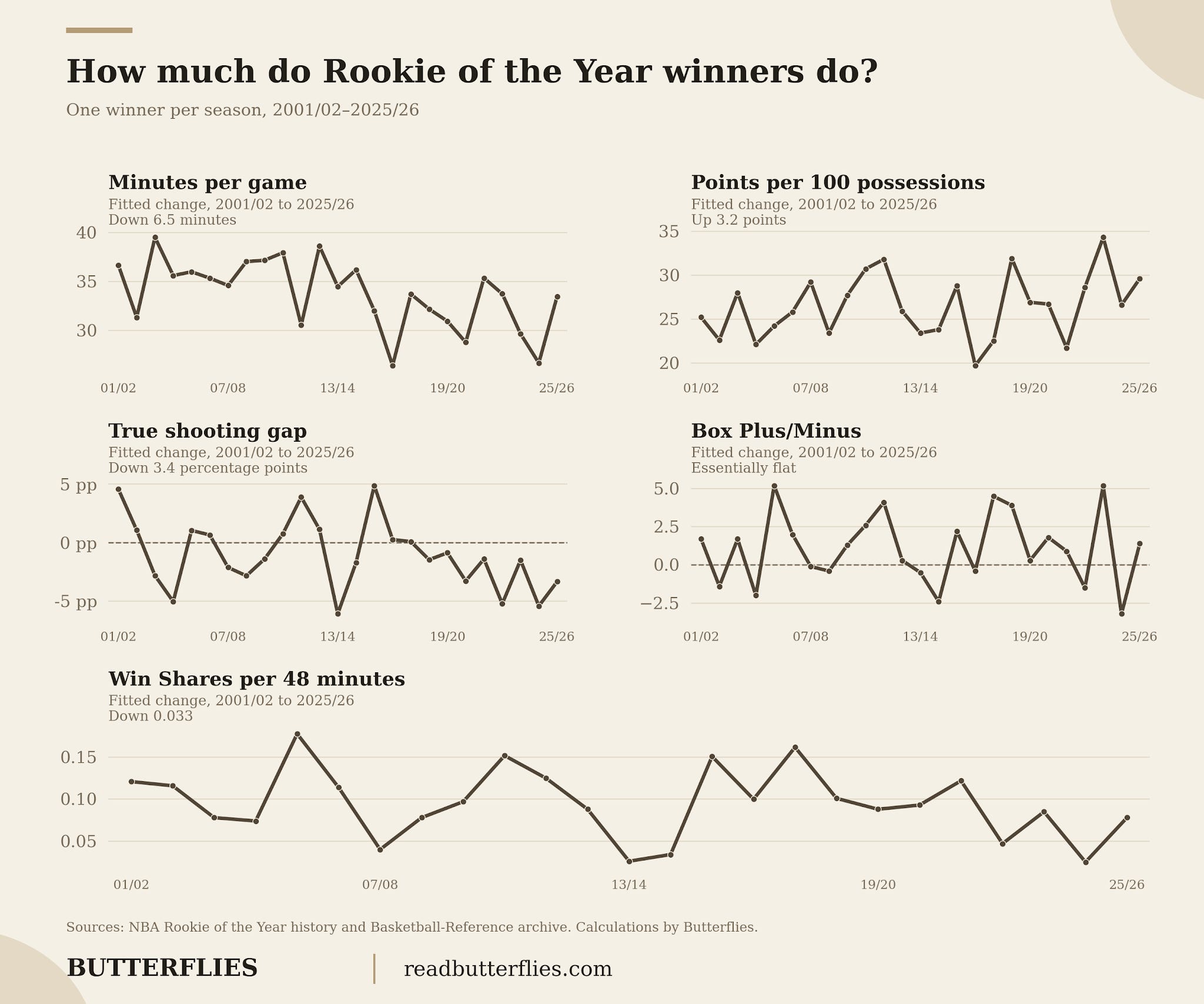
I wanted to go one step further. If you take the player voters picked out of each class, are those guys doing more right away? I looked at all 25 Rookie of the Year winners from Pau Gasol to Cooper Flagg.
The winners now are scoring more per 100 possessions and playing fewer minutes per game. Their true shooting has slipped relative to the league, and WS/48 has trended down. Box Plus/Minus is essentially flat.
Based on the metrics shown here, it’s hard to conclude that the best rookie in each class is better today than 25 years ago, but an argument could be made.
Why does it feel like rookies are more impactful now than in the past even though they aren’t?
I still understand the feeling that rookies are arriving more prepared. There are a few possible explanations, even if this analysis can’t prove it.
One possible explanation is simply how many rookies are earning minutes now. Across the last 25 seasons, the number of rookies appearing in an NBA game has increased, especially over the last 10 years. There were 69 rookies who appeared in 2001/02 and 103 in 2025/26. Over that same period of time, the number reaching 500 minutes went from 30 to 42, while those reaching 1,000 minutes went from 23 to 26.
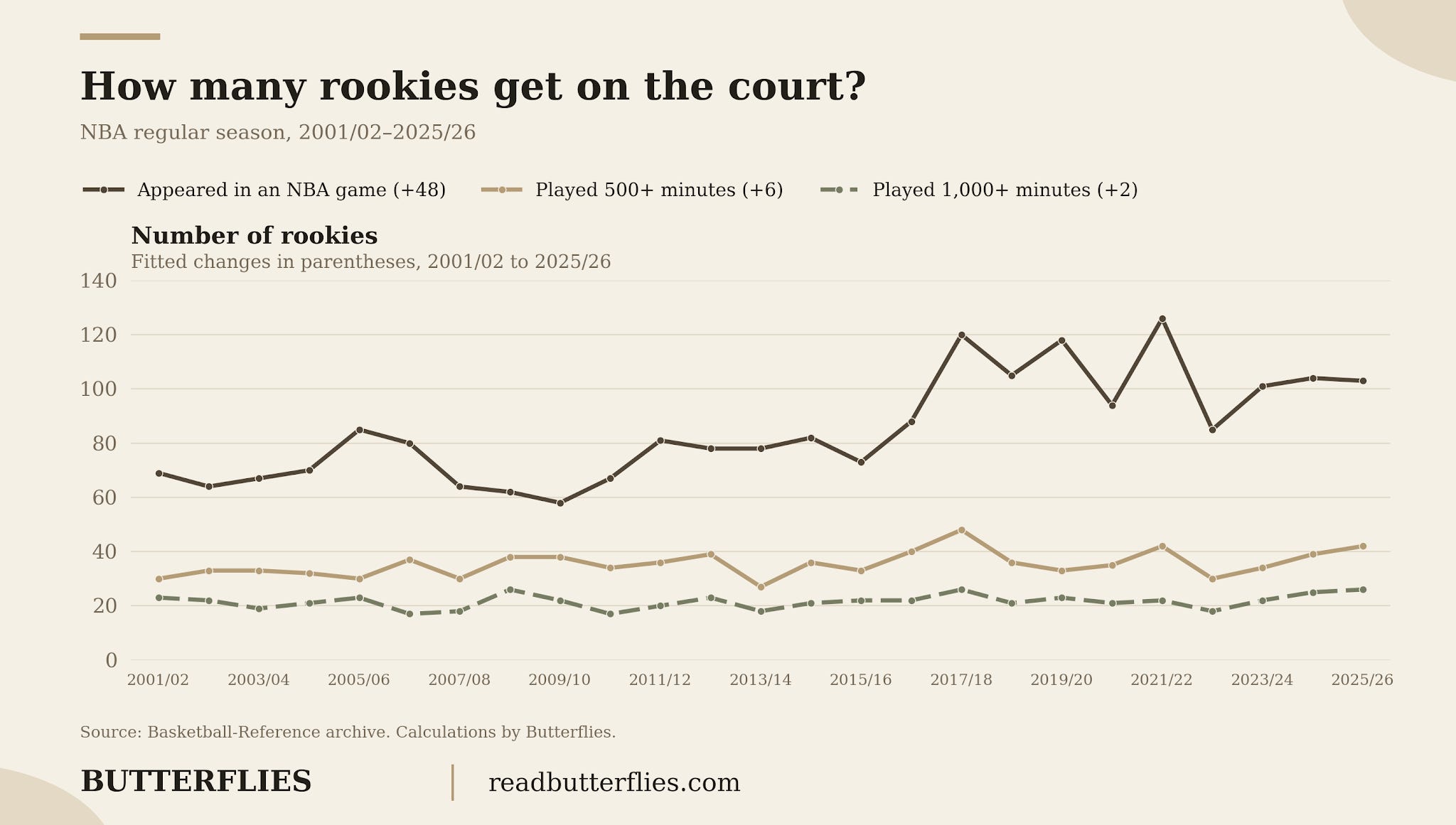
Most of the growth in the number of rookies appearing in games comes from players with fewer minutes. Roster expansion offers a possible explanation. The NBA introduced two two-way contract spots per team in 2017 and added a third in 2023. Rookie’s earning minutes jumped from 88 to 120 in 2017/18, coinciding with the introduction of two-way contracts. The timing fits. It’s a possible reason the league can feel full of prepared rookies while the impact measures show limited increases.
Then there’s the competition. As mentioned above, the NBA is more talented than ever. As part of that, younger players have to be stepping up, right?
Kirk Goldsberry looked at the league’s age for The Ringer and found that just 17.5% of the players who appeared in a game in 2025/26 were 30 or older, the smallest share in at least 30 years. With a younger league overall, some of the impact we perceive may be coming from players who are already in year two or three.
I looked at what second-year players actually accomplished, comparing each class with the second-year classes before it. Across all 25 seasons, the typical second-year player’s points per game and points per 100 possessions were essentially flat. Box Plus/Minus drifted slightly down, and WS/48 minutes barely moved. The same pattern held when I looked only at players with at least 500 minutes in their second season.
What did change was how many of them played. There were 56 second-year players in 2001/02 and 89 in 2025/26. Their share of league minutes rose from 8.9% to 11.6%. We’re seeing more second-year guys spending more time on the court. And so that brings us back to the idea of there just being a lot more young players, and players with fewer years of experience in the Association, compared to years past.
Players are being forced to grow up sooner instead of riding the pine. In 2001/02, the average age of an NBA player was 27.2 years old. In the 2025/26 season, it was 25.9 years old. Weighted by minutes played, the average age of the 2001/02 season was 27.4 years old and the 2025/26 season was 26.1 years old. It’s a young man’s league now.
What I’d Expect From a Rookie
I came into this expecting to find that the best rookies were taking on more responsibility and contributing more immediately. Looking at the last 25 rookie seasons makes that argument difficult to support. It’s likely that the league has become younger overall, including more rookies due to roster expansion rules, and that is contributing to the perception that rookies are entering the league more prepared.
However, there is also room for rookies to be more prepared than their predecessors in ways this analysis can’t measure. The eye test tells us rookies are more skilled and more athletic than rookies 25 years ago.
However, I’m still going to watch Boozer put up a triple-double against my Blazers and think, how is this guy a rookie? The eye test tells us rookies today come in with more skill and athleticism. What I’ll take from this analysis is that I probably should temper my expectations of my team’s rookies as they enter the league. Who knows, maybe one will surprise me one of these seasons.