


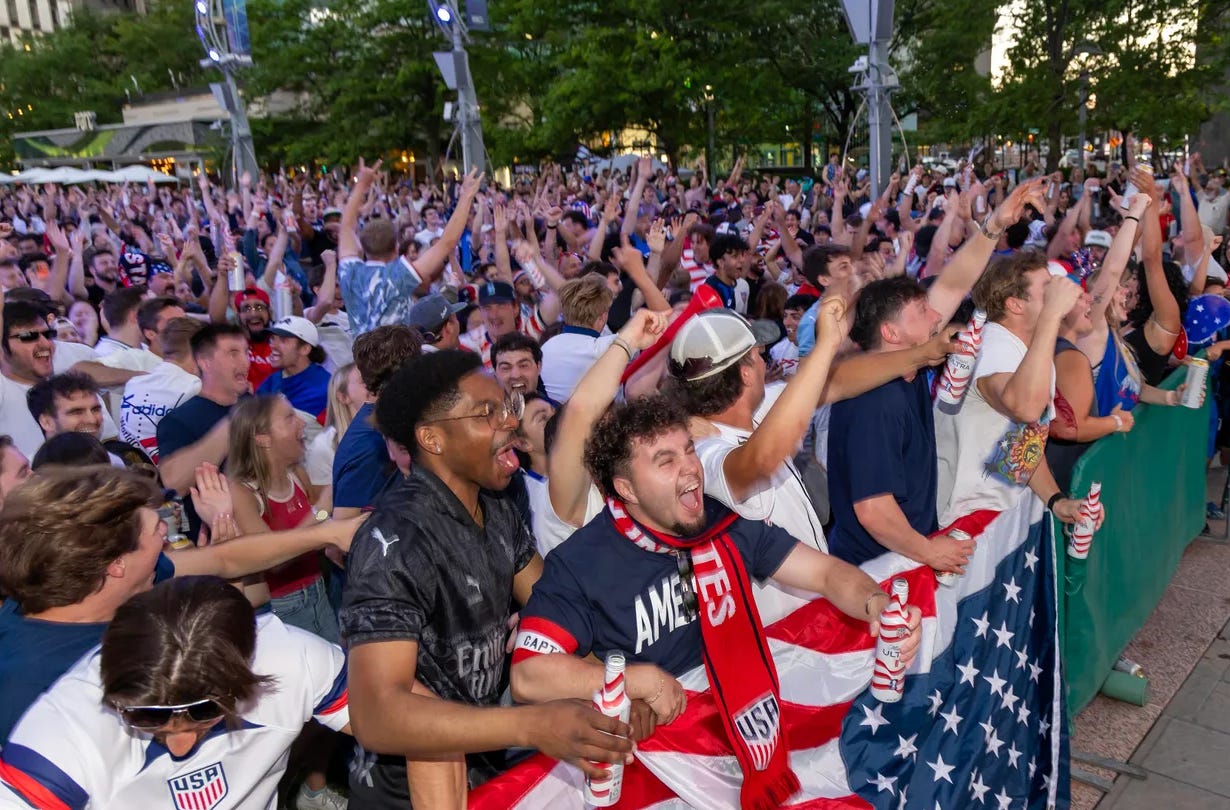
Fair warning, I use “football” and “soccer” interchangeably in this one. Soccer is what we say here in America, and it’ll show up when the American context calls for it. If that’s bothersome, I’d argue that tension is actually kind of the whole point.
The World Cup is being played in the United States this summer. I’m not going to lie, I was pretty hyped after the convincing 4-1 win over Paraguay on Friday. I’ve never seen the U.S. Men’s National Team play so well.
Balogun is in the early lead to win the Golden Boot, Pulisic was splitting defenders and causing chaos, McKinnie was constantly running in behind the defense, Tillman and Freeman were quietly all over the field, and Adams and Richards provided the stability we needed. Sure, it was against a Paraguay team that doesn’t have expectations to do much in this tournament, but the dominant performance has gotten my hopes up as a fan.
In anticipation of the World Cup, Nike and Adidas released their newest commercials to get us riled up. The commercials were star-studded, both in pop culture and legends of the game.
Nike’s commercial is titled “Rip the Script,” a nod to the fluidity of the beautiful game. It celebrated the flair and unscripted nature of football. Adidas’s title, “Backyard Legends,” highlighted the street culture and improvisation of pickup games.
Nike and Adidas continued the Joga Bonito and Impossible is Nothing themes from years past, not in name, but in expressing the spiritual home of the game. They represent what football means. A coming together of cultures, people, and communities. A celebration of creativity and talent.
Some of my favorite football commercials growing up represented this as well. From the cage match and Brazil’s locker room, to Jose +10, and Ronaldinho’s ping pong game with himself, they all sold us the dream of the beautiful game. It can be played anywhere with anyone at any given moment.
But watch those commercials long enough and a question creeps in. When did an American kid last actually do any of that to a point where it is celebrated? There certainly isn’t a male American player prominently featured in any of the commercials.
You Can’t Teach Culture
The U.S. is still a country that considers American football, basketball, baseball, and maybe even hockey more important to the cultural fabric of society.
The easy narrative is that America’s best athletes don’t play football, as I’ve attempted to debunk in the past. A more refined argument is that the pay-to-play model locks out talent. The more nuanced perspective is that even if we solve for cost (which MLS academies are starting to address, if you are in the right geography, talented enough to make it, and can find a way to support yourself until academy age), we still have a soccer culture deficit.
American kids don’t grow up playing pickup soccer on the streets the same way kids do in the Brazilian favelas or the boroughs of London. That pickup culture is what makes countries like Brazil great at the sport.
At the epicenter of football in Brazil is futsal. With futsal courts about the same size as a basketball court, futsal can be played in crowded cities surrounded by apartment buildings. Futsal courts are bound to have cracks and potholes after years of wear and tear. With the uneven playing surface and small area, young Brazilian players learn how to dribble and play in tight spaces.
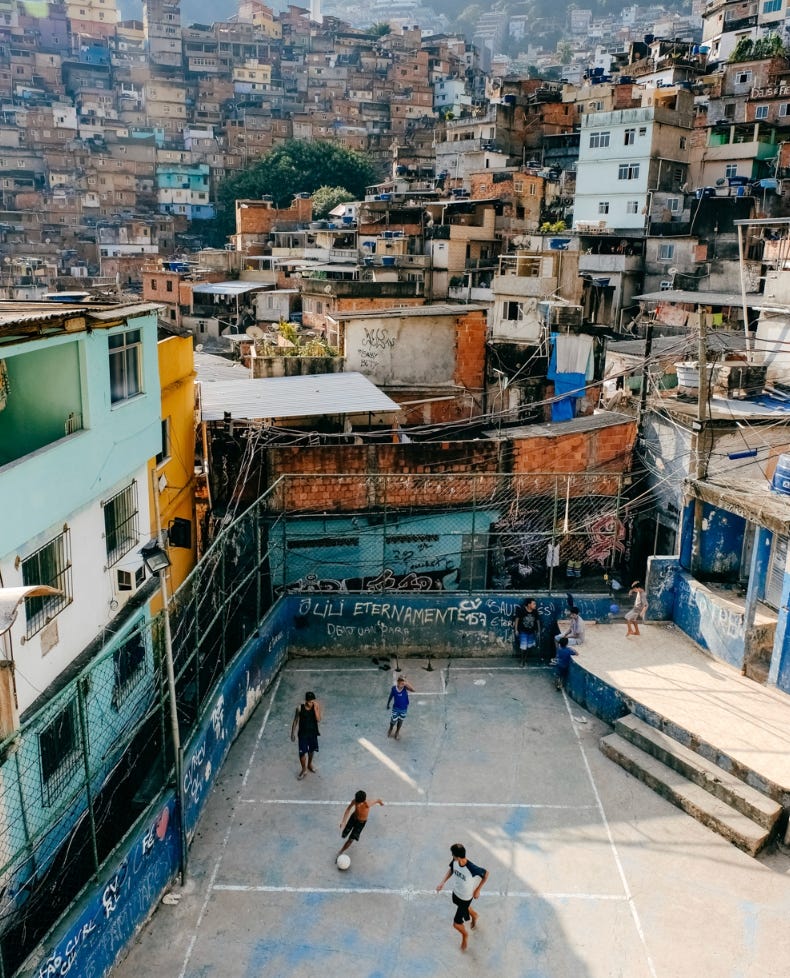
Pelé popularized the Portuguese phrase “Jogo Bonito,” meaning “the beautiful game.” Futsal is where much of the flair of the Brazilian game originated, with stars such as Pelé, Zico, Ronaldinho, and Neymar starting their careers playing futsal.
Carlos Alberto, the captain of the Brazilian team that won the World Cup in 1970, told the BBC:
“Football in Brazil is like a religion. This is the difference between Europe and Brazil. After the World Cup, people in Europe start to think about life, business. Here in Brazil, we breathe football 24 hours a day.”
Antony, a Brazilian playing for the storied Manchester United, said it best in The Players’ Tribune:
“The ball was my savior. My love from the cradle. We don’t care about toys for Christmas. Any ball that rolls is perfect to us...With a ball at my feet, I had no fear.”
In like manner, Adriano, a former Brazilian national team player, said:
“A ball was always at my foot. It was put there by God.”
In Brazil, everyone plays football — the kids, construction workers, drug dealers, and bus drivers. Dribbling a ball, everyone is equal, barefoot and all.
Soccer is not built into the culture of America like so much of the rest of the world. The aesthetics of the Nike and Adidas commercials have never been the reality for Americans. However, maybe this World Cup can slowly start to turn the tide. I mean, look at some of these Tweets and reactions after the Paraguay game:


Building Soccer in America
Look back at the 1994 World Cup on U.S. soil and what it did for soccer in America can give us a glimpse of what it can do for us in 2026.
When the U.S. bid to host the 1994 World Cup, FIFA made its position clear: you want the tournament, you build a league.
The U.S. had lacked a real professional soccer league since the North American Soccer League’s (NASL) demise in 1984. Major League Soccer was born out of that ultimatum, officially forming and beginning play in 1996. No World Cup, no MLS.
Soccer started to grow in popularity after the 1994 World Cup. In 1994, soccer ranked as America’s 67th favorite sport, right behind tractor pulling. However, soccer started to be televised more and more in America. Now, you can catch different leagues from all around the world on most of the major streaming platforms.
According to US Youth Soccer, there were more than 3 million registered youth soccer players in 2014, representing an almost 90% increase from 1990. In raw terms, that’s an additional 1.4 million kids playing over two and a half decades. Additionally, high school soccer participation increased fourfold among boys and 35-fold among girls from 1973 to 2014.
What drove this growth wasn’t just infrastructure. It was faces. American kids had players to look up to after the 1994 World Cup. Guys like Alexi Lalas, Cobi Jones, and Tony Meola became the heroes for a new generation of soccer fans. The U.S. women winning the World Cup in 1999, also hosted in the States, further introduced new faces to look up to.
Landon Donovan, widely considered one of the best American players ever, traced his obsession directly back to attending a ‘94 World Cup match as a kid.
The Ultimate Goal
Antony said the ball was his savior. Adriano said God put it at his feet. You don’t manufacture that relationship with a registration fee and Saturday morning orange slices.
America has spent thirty years building soccer from the top down. Leagues, youth clubs, television deals. It has produced real progress and real players. But the beautiful game was never built from the top. It was built in backyards, in favelas, and on cracked futsal courts.
The 1994 World Cup put soccer on screens that had never shown it before, in front of audiences that had never sought it out. Some of them stayed curious. Their kids grew up curious. And gradually, that curiosity compounded into something that has culminated in what we saw on Friday.
But the most exciting part is what happens next for U.S. soccer. The 2026 World Cup will be loud and bright and maybe, if things break right, genuinely historic for this country.
But what will it do for the next generation? Will the Nike and Adidas commercials actually play out here in the States? Will kids go out to their backyard to kick a soccer ball instead of throwing a football around? Will schools and parks start to build futsal courts instead of basketball courts? Will kids kick around anything that rolls?
This is the next phase of building a soccer culture in America. It needs to be ingrained into the DNA of our country. Build the culture. The rest will follow.