


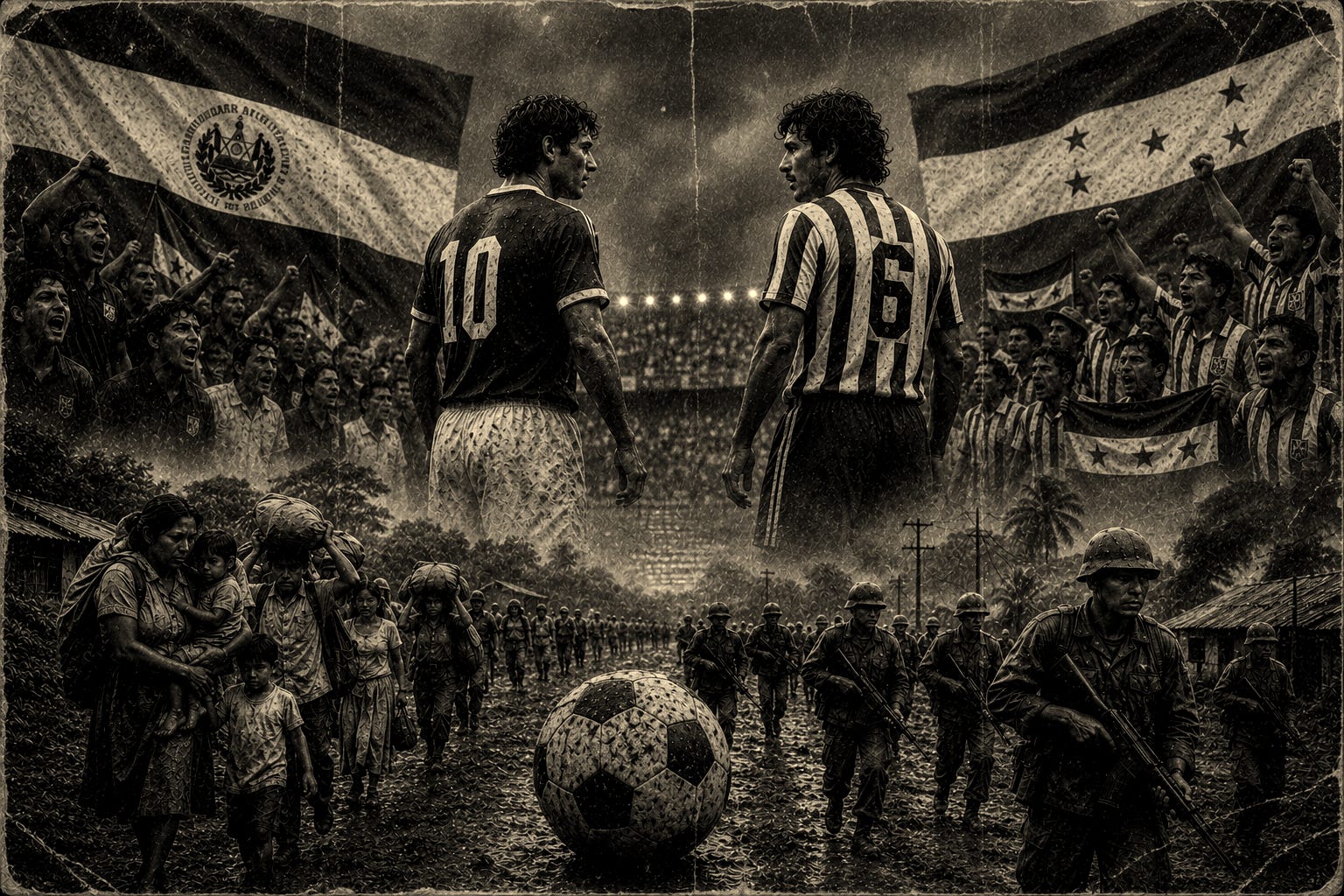
I’ve always been fascinated with the intersection of geopolitics and football. The Argentina vs England game in the World Cup re-energized me to do more research in the space. As I was thinking about it, I was reminded of another rivalry I had come across previously between El Salvador and Honduras. Maybe I’m in the minority, but up until I came across it, I had never heard of the history between the two countries.
So I went down the rabbit hole and found out why the story often told isn’t exactly what happened.
The Background
El Salvador and Honduras had lots of similarities when it came to football. In the 1960s, they were two young football nations still finding their footing. El Salvador’s top flight didn’t take its modern shape until 1969, while Honduras’ Liga Nacional had only turned professional four years earlier, in 1965.
Outside of football, the countries also have many similarities. They share the same language, religion, and have similar cultures. In the 1960s, both Honduras and El Salvador even had similar authoritarian military governments. But that’s where many of their commonalities stop.
El Salvador was dominated by a small landholding elite. Most of the best arable land was owned by a few families. As land became more and more scarce, many Salvadorans crossed into non-settled neighboring Honduras, where they created their own communities and farmed the land. By the 1960s, it was estimated that 100,000-300,000 Salvadorans had migrated into Honduras.
In contrast, Honduras was a large and sparsely populated country ravaged by poverty and political instability. As Salvadorans moved to Honduras, a land reform initiative in 1967 led to a growing nationalist sentiment in Honduras.
The reform law essentially asked all Salvadorans to go back home. When they did not go, the Honduran president, who gained power six years earlier by military coup, forced thousands out. Handbills appeared throughout Honduras:
Guanaco: If you believe yourself decent, then have the decency to get out of Honduras. If you are, as the majority are, a thief, a drunkard, a lecher, crook, or ruffian, don’t stay in Honduras. Get out or expect punishment.
This tension was escalated by a history of land and maritime boundary disputes between El Salvador and Honduras. Salvadoran media also spread reports of the persecution of migrants in Honduras.
The triple combination of these social, economic, and territorial tensions created the perfect storm for what was to come as the 1970 World Cup qualifiers were well underway.
The Football
On June 8th, 1969, El Salvador and Honduras were set to play the first of two scheduled World Cup qualifying matches in Tegucigalpa, Honduras. Six days earlier, on June 2nd, the first wave of Salvadoran families was forced from their homes and sent over the border to El Salvador.
Within hours, Red Cross refugee centers said the intake of Salvadoran refugees was overwhelming. Local Salvadoran newspapers and radio stations claimed Hondurans were murdering and committing mass rape during the expulsion; however, the Red Cross said they saw no evidence of such vile behavior. In a 1981 book, Thomas P. Anderson said human rights abuses “were isolated cases and not so widespread as generally believed in El Salvador.”
However, the damage was done. Tensions were high during the match in Honduras, which included fighting in the streets throughout the entire match. Honduras won 1-0.
On June 15th, just seven days after the first match, Honduras traveled to El Salvador for the second qualifying match. Honduran players traveled to the field in armored cars. More outbreaks of violence occurred between the two fanbases. El Salvador won decisively, 3-0.
Following the second game, Honduran media picked up where the Salvadoran media started, claiming the same vile acts were committed against Hondurans. Anderson said the Honduran media claimed hungry and thirsty Hondurans were served urine and manure and women were stripped and violated in the streets. However, he said, “Those of us who were there saw nothing of the kind, but it was impossible to intrude any rational statements into the Honduran press.”
Later, a human rights subcommittee would say, “the press and radio bear an enormous responsibility” for the war that later occurred.
As fate would have it, El Salvador and Honduras would meet a third time, just 12 days later on June 27th. The two met in a playoff at the Azteca in Mexico City to determine a spot for a place in the last playoff game vs Haiti to decide who would play in the following summer’s World Cup.
By this time, it had been three and a half weeks since the conflict at the border started. The situation continued to deteriorate so much that on the day of the match, the Salvadoran government cut off all diplomatic relations with Honduras, accusing them of “crimes which constitute genocide.”
Said the El Salvador captain of the situation, “We were focused on qualifying, but we knew the conflict was there.”
The stage was set for the all-important game between El Salvador and Honduras. The game was played at night in heavy rain. Despite all the tension surrounding the game, the El Salvador captain said, “On the field, we respected each other. Even today [30 years later], the ones still alive [from the Honduras team], we have a strong friendship.” Interestingly enough, there were no cards produced the entire game.
Eight minutes in, El Salvador’s striker, Mon Martínez, got space at the edge of the box and ripped a left-footed shot past Honduras’ keeper. Honduras quickly answered with a goal from José Enrique Cardona, a 30-year-old talent playing for Atlético Madrid.
Martínez restored the lead before half to help El Salvador take a 2-1 lead into the break. Honduras leveled again early in the second, and it stayed that way through a downpour.
In extra time, El Salvador’s Pipo Rodríguez restored a lead that wouldn’t be relinquished again. El Salvador beat Honduras, giving them a chance to play for a spot in the World Cup. The game ended with handshakes all around between the two teams.
Said Mauricio “Pipo” Rodríguez after scoring the winning goal, “That goal will always be a source of sporting pride…The authorities and politicians made use of our sports victory to glorify El Salvador’s image.”
However, he continued by saying, “Neither from the Honduras players nor from our side were the games between enemies, but between sports rivals.”
Rodríguez was right that the players weren’t enemies. Their governments, however, had already decided otherwise.
The War
In the days after the match, more and more skirmishes broke out on the border. Seventeen days after the game in Mexico, on July 14, 1969, the Salvadoran Air Force struck Honduras. A Salvadoran ground invasion quickly followed. A war between the two countries officially began.
El Salvador quickly advanced across the border, capturing several towns and threatening the capital. Civilian casualties occurred in large numbers. The Honduran army eventually regrouped and slowed the Salvadoran progress.
On July 18th, approximately 100 hours after the start of the war, a ceasefire was agreed upon. In that time, about 3,000 people died, the majority being Honduran civilians. Under international pressure, El Salvador finally withdrew its forces in August 1969.
Trade between the two countries was cut off for decades, and the borders were closed. El Salvador also had to figure out what to do with hundreds of thousands of refugees who were removed from Honduras and were back in the country. Due in part to the socioeconomic challenges this war caused El Salvador, a civil war broke out from 1979 to 1992, where more than 70,000 people died.
While the war had more dire consequences, the football outcome was minimal. El Salvador went on to beat Haiti to qualify for the World Cup. However, they lost all three games the next summer and didn’t score a goal.
The Football War
The “Football War“ nickname traces back to a headline that ran in American papers the morning after the decisive qualifying match. In 2001, a retired U.S. diplomat said, “It was a difficult job trying to get anybody in Washington…to take [that conflict] at all seriously. Everyone had the same reaction: Oh, it’s crazy in Central America, banana republics having a war over a soccer game or something.”
The truth is, the conflict was already escalating towards a war whether the two countries played football or not.
Cristian Villalta, editor of a Salvadoran paper, said, “This was two military dictatorships using the games to exacerbate nationalism.” Calling it the Football War, he adds, is “like saying World War II broke out because of the artistic failure of Adolf Hitler in Vienna. It’s nonsense.”
The football was real, the rivalry was real, but the war was never actually about either. Argentina vs England reminded me why these histories are fascinating. Football rarely starts the fire, but it’s almost always nearby when one breaks out. El Salvador and Honduras didn’t go to war over a football game. They just happened to be watching one when the real war began.
This was a great read! It’s a shame a war broke out and there were many casualties.
Good insights, Austin. You've laid out so many angles to this historical event. And even then, the complexities of conflict are always hard to encapsulate. But thanks for bringing more perspective to football and war.