


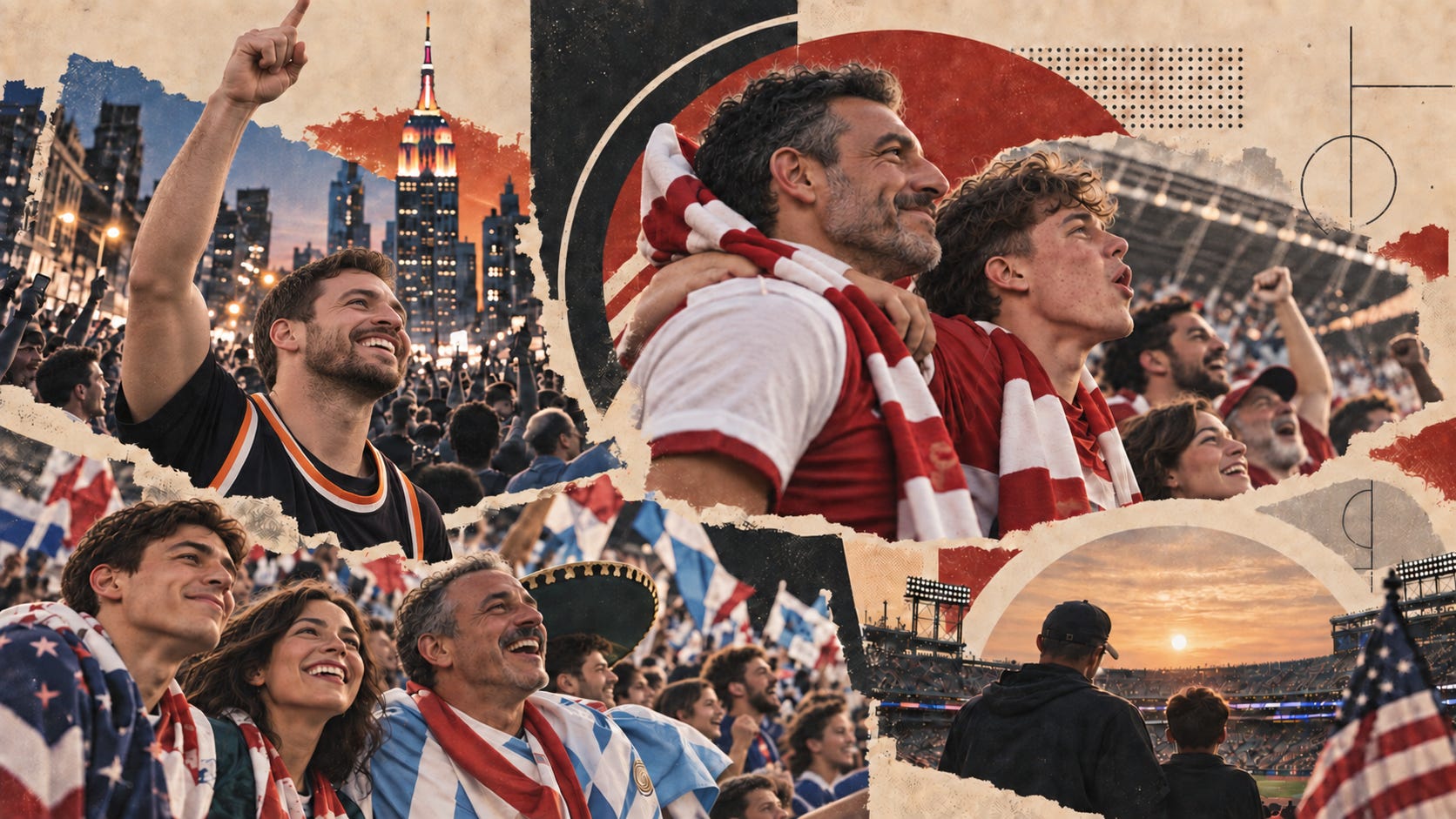
You know those lulls and ruts you enter into throughout your life? Maybe you are in one of them now. Or in one more often than you would like. You know, that’s ok. It’s just part of life. One of my favorite quotes is from Jenkin Lloyd Jones, which he wrote in a newspaper column and was later popularized by Gordon B. Hinckley:
“Life is like an old-time rail journey—delays, sidetracks, smoke, dust, cinders, and jolts, interspersed only occasionally by beautiful vistas and thrilling bursts of speed. The trick is to thank the Lord for letting you have the ride.”
The point of the quote is to enjoy the journey and be grateful for both the ups and the downs. I think this is good advice. As Andy Bernard from The Office said, “I wish there was a way to know you’re in the good old days before you’ve actually left them.”
It takes perspective to recognize when we are in the “ups” of life. But what if I told you that one sure way to have an “up” is to experience sports?
I think the summer of 2026 was the greatest in sports history. We were bombarded by sporting event after sporting event. But even better than that, we were reminded why sports are so great. Sports pull people together.
Think about what we witnessed.
Arsenal won the Premier League for the first time in 22 years in May. Knicks fans poured into Manhattan after their first championship in 53 years, singing New York City classics that stand the test of time.
Americans sang “Country Roads” after World Cup matches and broke viewership records along the way. Fans from around the world filled cities, big and small, across the U.S., Mexico, and Canada, chanting, singing, and gathering across cultural and ethnic boundaries.
Then in September, right as the weather was changing to fall, the 25th anniversary of 9/11 reminded us of how sports helped a nation heal.
Sports Builds Communities
Arsenal and the Knicks won the Premier League and NBA championship at the beginning of the summer. A sports team can give people who have nothing in common a shared identity. You can’t help but root for people’s happiness. Just look at them in these videos.
Then the World Cup took it to another level.
My pastime this summer was watching World Cup visitors experience America for the first time. We watched them bring their chants and traditions to Times Square. They brought the beautiful game to our NFL stadiums. And the European and South American atmospheres were transmitted to our television sets for the rest of America to experience.
I embraced this World Cup more than I ever have. I had the privilege of going to two games myself. I was there during the introduction of the USMNT’s unofficial anthem versus Australia. The pop and party in the stands after Malik Tillman’s free kick against Bosnia was unlike anything I’ve ever felt in a stadium.
Coming home from the U.S. vs. Bosnia and Herzegovina game, my friend and I wore our USA jerseys through the airport. An older couple talked our ears off the entire time about how they’d watched the game the night before. They just kept going. And this was at 6:30am.
We then had a bit of a drive from the airport after landing. We stopped at a gas station in a podunk town in the middle of nowhere. As we were getting back in the car after grabbing some snacks for the road, a guy started telling us he’d watched the game the night before too. He said he’d never really watched soccer before.
He asked us about Folarin Balogun’s red card, and whether that meant the U.S. would have to play the next game with ten men. My friend explained the rule to him and confirmed we’d still have eleven men, but Balogun would be suspended (well, so we thought). The conversation ended with the guy saying he’d be tuning in for the Belgium game. We never would have talked to him if it wasn’t for sports.
And then there was the 25th anniversary of 9/11. Sports brought a country together during tragedy and heartbreak. Sports were a symbol of overcoming evil. And we were reminded of that again this year, a quarter century later.
Maybe This Feeling Is Measurable
Maybe that feeling of belonging isn’t just something sports fans convince ourselves is real.
A 2024 study used three different methods to test whether watching sports improves well-being. One analysis used data from roughly 20,000 Japanese adults, another was an experiment where people watched sports videos, and a third used MRI brain imaging. Across all three, watching sports was positively associated with well-being.
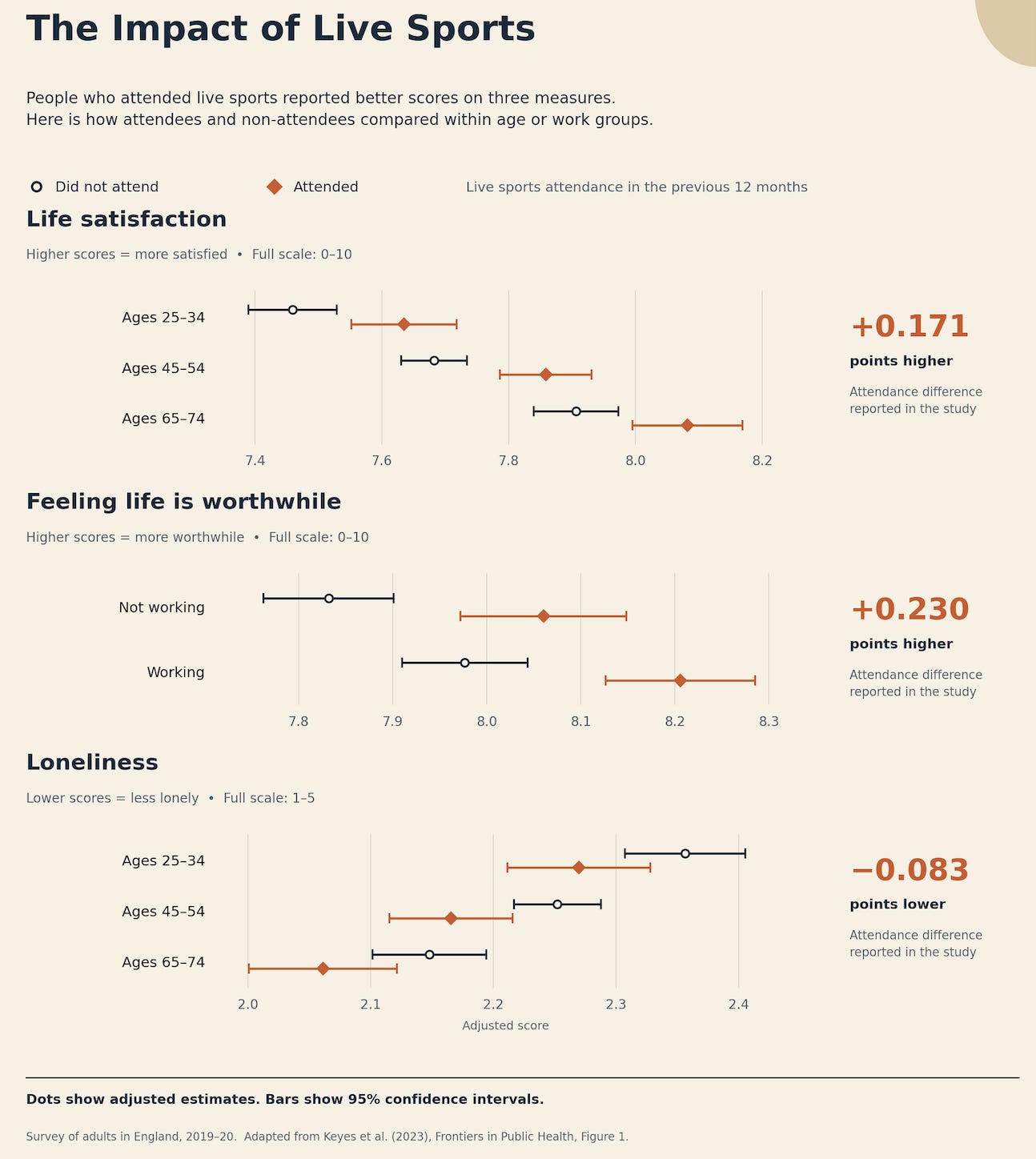
Additionally, in 2023, researchers looked at more than 7,000 adults in the UK and found that people who attended live sporting events reported higher life satisfaction, a greater sense that their lives were worthwhile, and less loneliness.
The study can’t show that attending games caused happiness or connection. But even after researchers accounted for things like age, health, employment, and economic circumstances, the relationship was still there.
People who went to sporting events seemed to feel a little better about their lives and a little less alone. It’s hard to deny that after watching millions of North Londoners, New Yorkers, and fans across the world pour into the streets together.
While writing this, I was reminded of a book called Soccernomics, which I read a few years ago. One of the authors, Stefan Szymanski along with Georgios Kavetsos, looked at self-reported life satisfaction across 12 European countries over three decades. They compared that data with major sporting events, including the World Cup and European Championship.
The findings showed that a country hosting a major football tournament was associated with increased life satisfaction. And once the tournament was over, the boost in life satisfaction then seemed to disappear.
The researchers also found only limited evidence that a country’s success on the field had a positive impact on how satisfied people were with their lives. In other words, the thing making people happier wasn’t winning, but experiencing the football tournament itself.
What’s even cooler is that researchers later analyzed data in France after the World Cup was hosted there in 1998. They looked at suicide data from 1979 through 2006 to see if the tournament had any measurable effect. During the month of the World Cup, there were 95 fewer suicides than researchers statistically expected, which was a 10.3% decline.
On days immediately following games played by the French national team, suicides were 19.9 percent lower than expected. The decline was especially pronounced among men between the ages of 30 and 44.
The researchers pointed to hypotheses around belonging and social integration. When an entire country becomes wrapped up in the same event, people may feel a little less isolated from everyone around them.
The study can’t tell us that 95 specific people were saved because France hosted the World Cup. It also can’t prove that football itself caused the decline. But 95 is a remarkable number. That’s 95 people who are still around as a brother, sister, father, mother, daughter, and/or son. And football may have played a part in it.
Which brings me back to this summer. Maybe the important part wasn’t whether the U.S. beat Belgium. Yes, we’d all love it if our team had won, but that’s not what the lasting message was about. The memory that will last was the millions of people having somewhere to go, something to talk about, and someone to experience it with.
Sports are entertaining. And most of the time that’s enough. But every once in a while, they seem to give us something a little more important, maybe like life itself.
We’re Running Out of Places to Belong
So much of modern life has become individualized. We stream shows alone. We work without leaving the house. We order food to our door. But these studies all point to the fact that belonging matters. Sports are really good at helping us realize that.
Sports are one of the few things left where millions of people care about the exact same thing. And then willingly wear the same colors, sing the same songs, and experience the same emotions together.
I called this summer of 2026 the greatest summer in sports history. I’m sure someone could point me to a summer with better games, better athletes, or more dramatic finishes. But I know what I felt, and I’m sticking to my proclamation.