


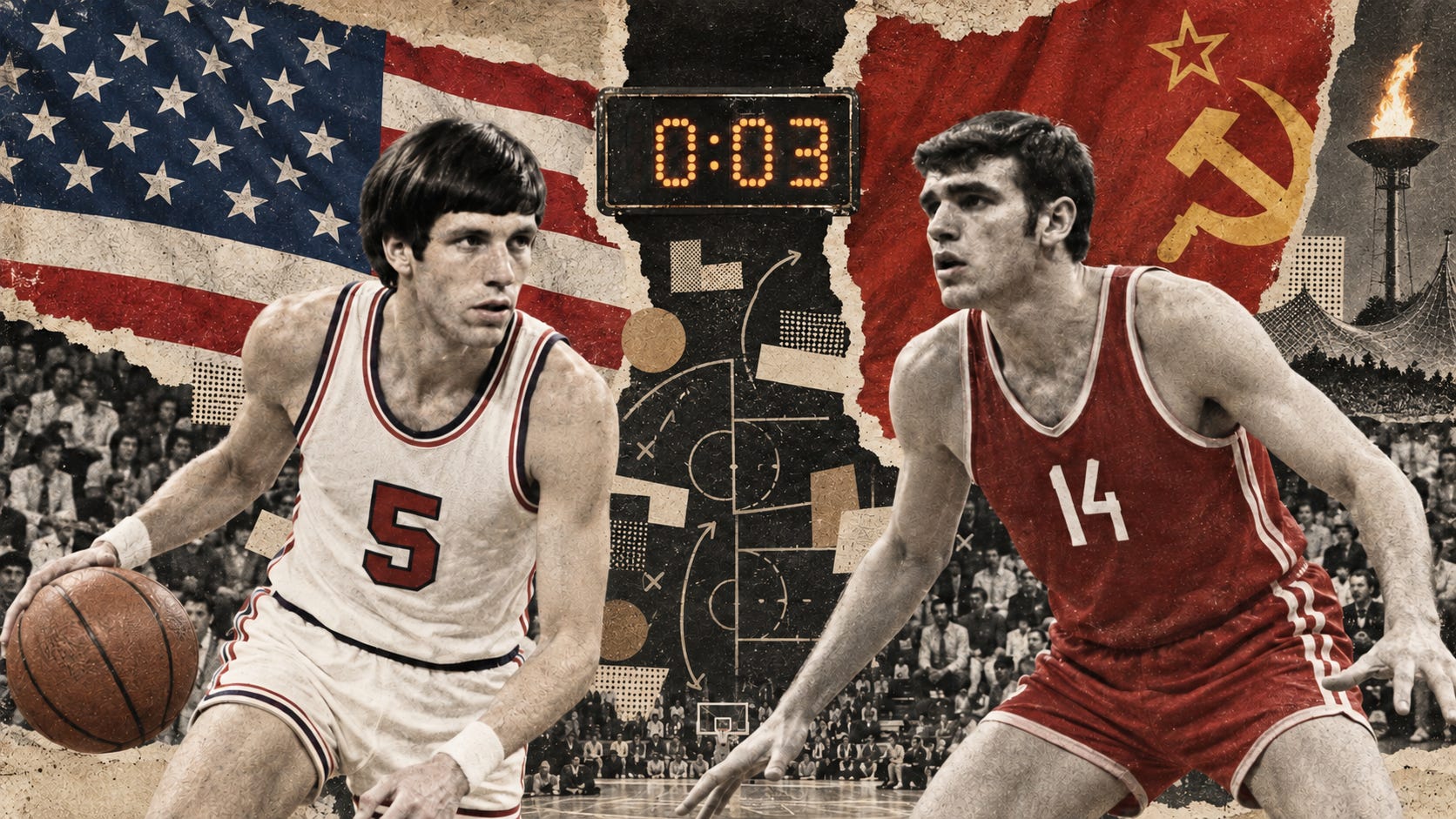
Every fan loves reliving unforgettable sports moments. I am honoring that nostalgia with a Butterflies series called “Replays.” Each edition will revisit a memorable moment, add historical context, uncover a number or statistic, capture the reactions it inspired, and trace the butterfly effect it set in motion.
Context
College football just kicked off, and it only took the first weekend to produce some real controversy. Michigan defeated Western Michigan in a game that saw the clock hit zero with Western Michigan leading. And then one second was added back on the clock. Michigan threw a game-winning Hail Mary in what will be a game talked about for a long time.
54 years ago this month, the 1972 USA vs. Soviet Union basketball game for the Olympic gold in Munich had a similar fate.
1972 was the peak of the Cold War. The Americans and Soviets were world powers and competing in ideology, space, weapons, and yes, even sports.
But basketball belonged to the United States. It was an American sport, and the rest of the world was just catching on. The USSR was a good team that practiced and played together frequently.
At the time, America sent college kids to compete who only had a few practices together before the Olympics. But again, this was basketball. And Americans owned basketball. The US men’s basketball team had won 63 consecutive Olympic games and had won every gold medal since basketball became an Olympic sport in 1936.
During the gold medal game, the Soviets came out firing. The US kept it close, but the USSR led the entire game. That was until the final three seconds, with Doug Collins at the free-throw line.
The Moment
There isn’t great footage of the game on the internet without commentary and voiceover. This is the best video I found. You’ll need to watch it in two instances to fully see what happened.
First, watch this clip from 1:13:20 to 1:16:12. When the commentary starts, come back here for the second clip.
Watch this second clip from 1:22:16 to 1:24:14.
Below is the written description if you need extra context:
With three seconds remaining in the game, Doug Collins was fouled hard while driving to the basket and took a while to get up. When he finally came to, he knocked down two free throws, giving USA a 50-49 lead, their first of the night. While taking his second free throw, you can hear the horn go off, but it was ignored, and the game continued. The horn going off will be a constant during the last three seconds of gameplay, which adds to the chaos.
The Soviets immediately inbounded the ball. As they made their way to midcourt, the officials stopped the play with about one second remaining because the Soviet coach was screaming for a timeout.
Apparently, he had requested a timeout to occur after the made free throw, but it wasn’t acknowledged. Even the FIBA Secretary General walked onto the floor from the stands, signaling that three seconds should be put back onto the clock. The referees decided to reward the USSR with the timeout and replay the inbound with three seconds left after the made free throw.
The Soviets inbounded the ball again, and the horn went off almost immediately. The Americans celebrated on the court as if they had just won the gold medal. But they hadn’t. The clock hadn’t been properly reset to three seconds. The officials had to remove the USA players, staff, and media from the court to replay the final three seconds, yet again.
This time, the clock was set properly back to three seconds. Soviet guard Ivan Edeshko was the inbounder and threw a length-of-the-court pass. Aleksandr Belov out-battled both Jim Forbes and Kevin Joyce and laid the ball up right before the final buzzer. The final score: USSR 51. USA 50.
The Numbers
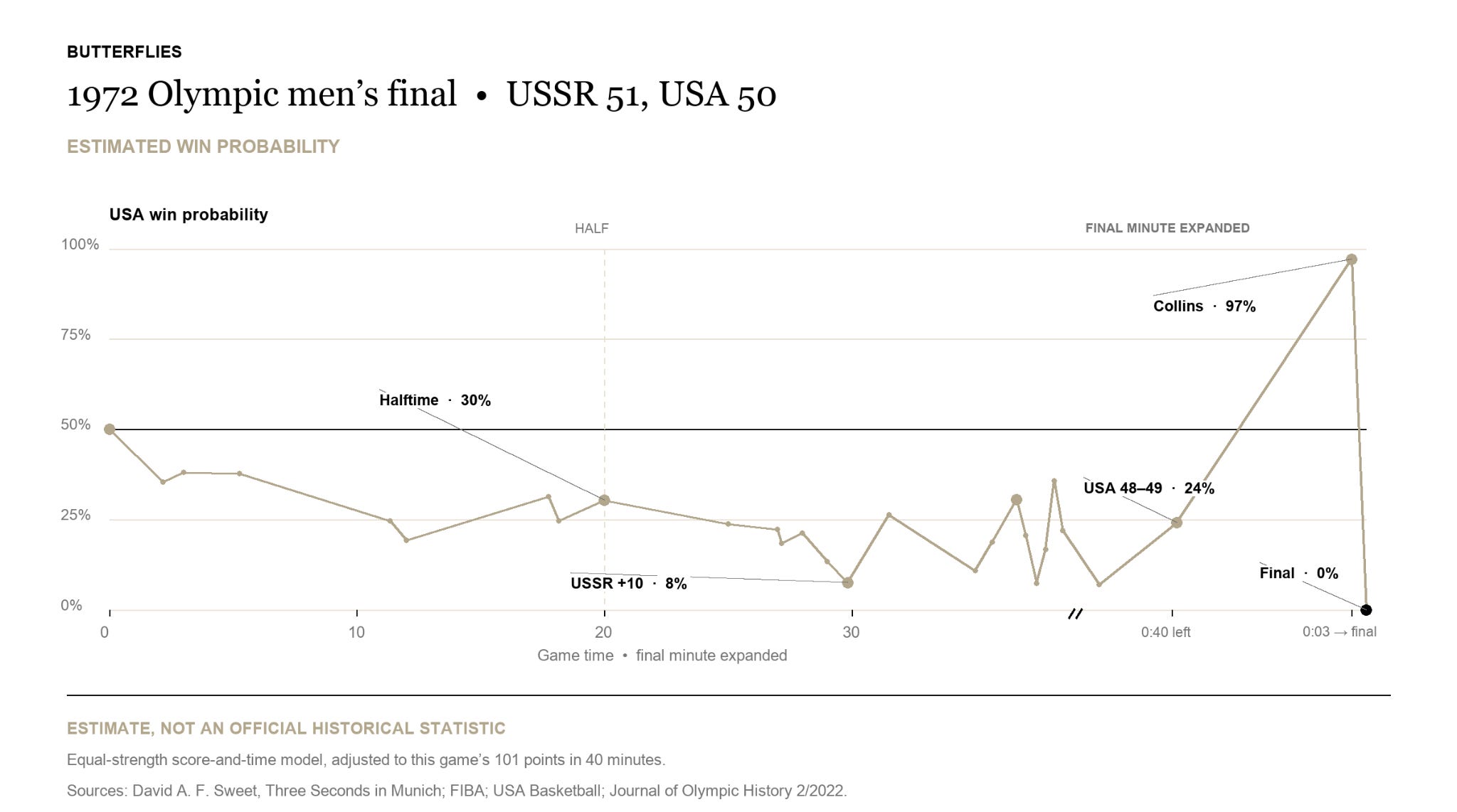
For nearly the entire game, the United States’ estimated win probability remained below 50%. Even after a made basket closed the Soviet lead to 49–48 with 40 seconds left, the US still only had a 24% chance of winning.
Then came the swing. Doug Collins’s free throws put the United States ahead 50–49 with three seconds remaining, sending its estimated win probability to 97%. One full-court pass and an Alexander Belov basket later, it swung back in favor of the Soviets.
Reactions
Team USA
The Americans immediately tried to appeal the game to a five-person FIBA jury. The last-ditch effort was rejected 3-2. It was a moment where the context of the Cold War found its way into sports since the three countries that declined the appeal were all Eastern Bloc countries.
In protest, the Americans didn’t attend the medal ceremony and still haven’t collected their medals. The US captain, Kenny Davis, even put instructions in his will that his wife and children were to never accept his medal.
YouTube Comment Section






The Butterfly Effect
Before the Munich Olympics, US Olympic basketball had a repeatable pattern: Send college kids, win the gold, celebrate, repeat. This gold medal game showed the weakness in that system.
The Soviets had continuity, experience, and players accustomed to international basketball. The Americans assembled a new group of college stars every four years and expected talent to win out. The rest of the world was catching up.
For another two Olympic games, the U.S. continued using amateurs. The US won gold in 1976, boycotted the 1980 games, and won gold in 1984. Then they lost again to the Soviet Union in 1988, this time in the semifinals.
One year later, FIBA changed eligibility rules, allowing professional players to play in the Olympics. That’s what set up the Dream Team in the 1992 Olympics. The US wanted to show it was still superior in basketball, a sport it invented. But 1972 is what put the US on notice that the rest of the world was finally catching up.