



Every season, we find ways to convince ourselves that this could be our team’s year. Having something to believe in is part of why we keep coming back. You don’t need to win every year to enjoy being a fan. Most of us would settle for believing that, someday, we could. But what about football club fans who haven’t challenged for a title in decades? Or ever?
That question brings us to Manchester City’s financial doping case. City became the contender its fans had dreamed of, but did so by breaking financial rules. Then there’s the question of whether those rules allow for small clubs to even dream of winning.
We’ll get into both, but first, here’s a quick overview of how football’s financial rules work.
How The Financial Rules Work
European football doesn’t have traditional salary caps. The key idea is that an owner’s wealth and a club’s spending allowance are different things. The rules limit how much owners can fund beyond what the club earns.
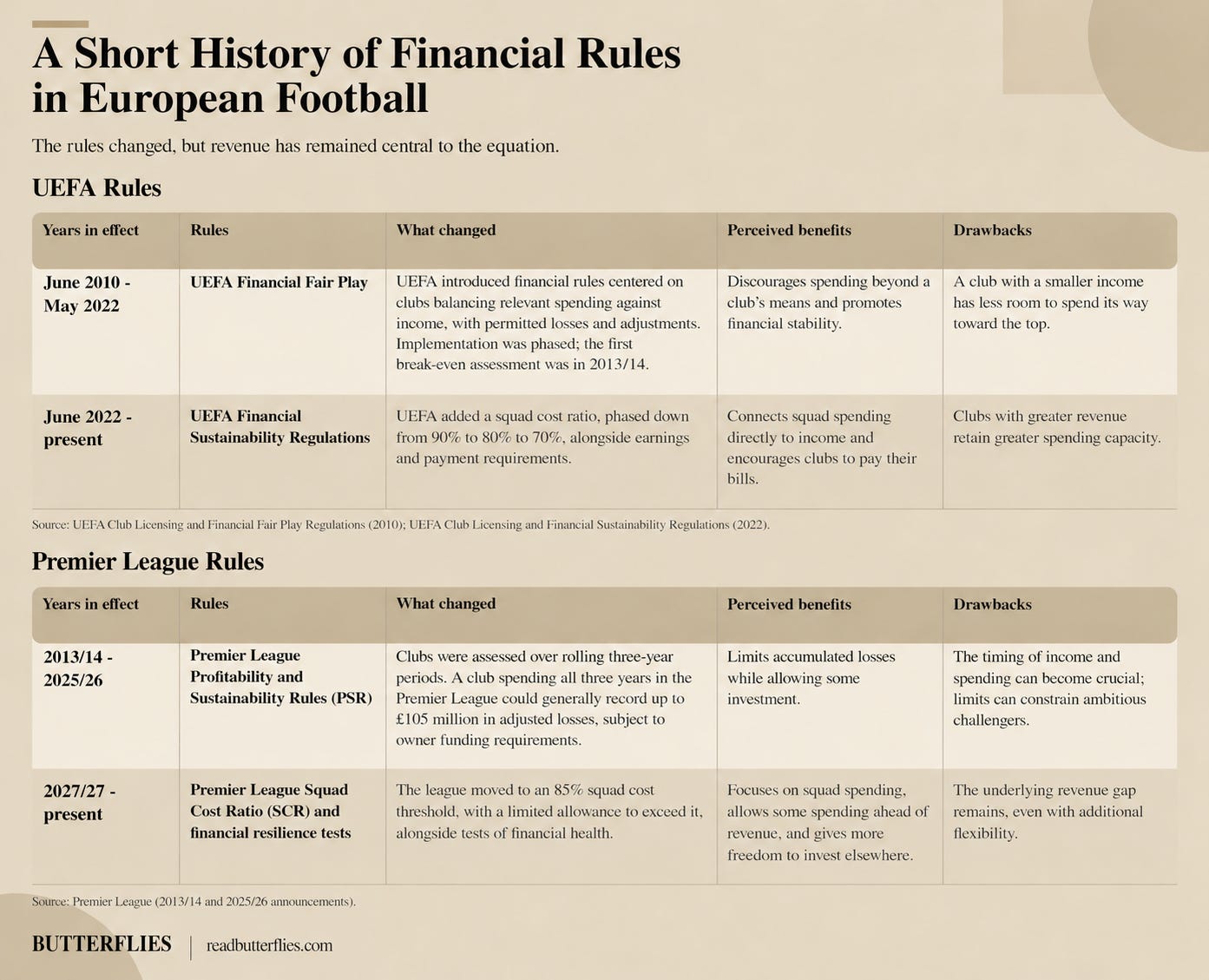
Under the old Premier League rules, a club could lose up to £105 million across three years. That number excluded some spending, including qualifying investment in academies, women’s football, community projects, and infrastructure.
Starting in 2026/27, the Premier League introduced a new system. Its basic rule is that clubs can spend 85% of their football income on their team. That team spending includes player and head coach wages, agents’ fees, and transfer costs. Transfer fees are usually spread across a player’s contract. For example, a £50 million transfer fee on a five-year contract would generally count as £10 million a year.
There is some flexibility above 85%. Clubs start with an extra allowance of 30 percentage points, which shrinks as they use it. Spending above 85% can lead to financial penalties and points deductions. Clubs playing in UEFA competitions are also required to meet UEFA’s stricter 70% squad spending limit.
An owner can build a better stadium, improve training facilities, or invest in an academy. Those things can help the club earn more money, which eventually leads to spending more on players. But they can’t just write a check to the club and count it as revenue to offset expenses.
Manchester City’s Financial Breaches
Money has always been the historical answer to improving a squad and moving up the league table. More money in football generally means better players, a better manager, improved facilities, and more winning.
This is what Manchester City experienced in 2008 when the club was bought by Sheikh Mansour, a member of Abu Dhabi’s ruling family and currently the Vice President of the UAE. The new owner had money. Lots of money.
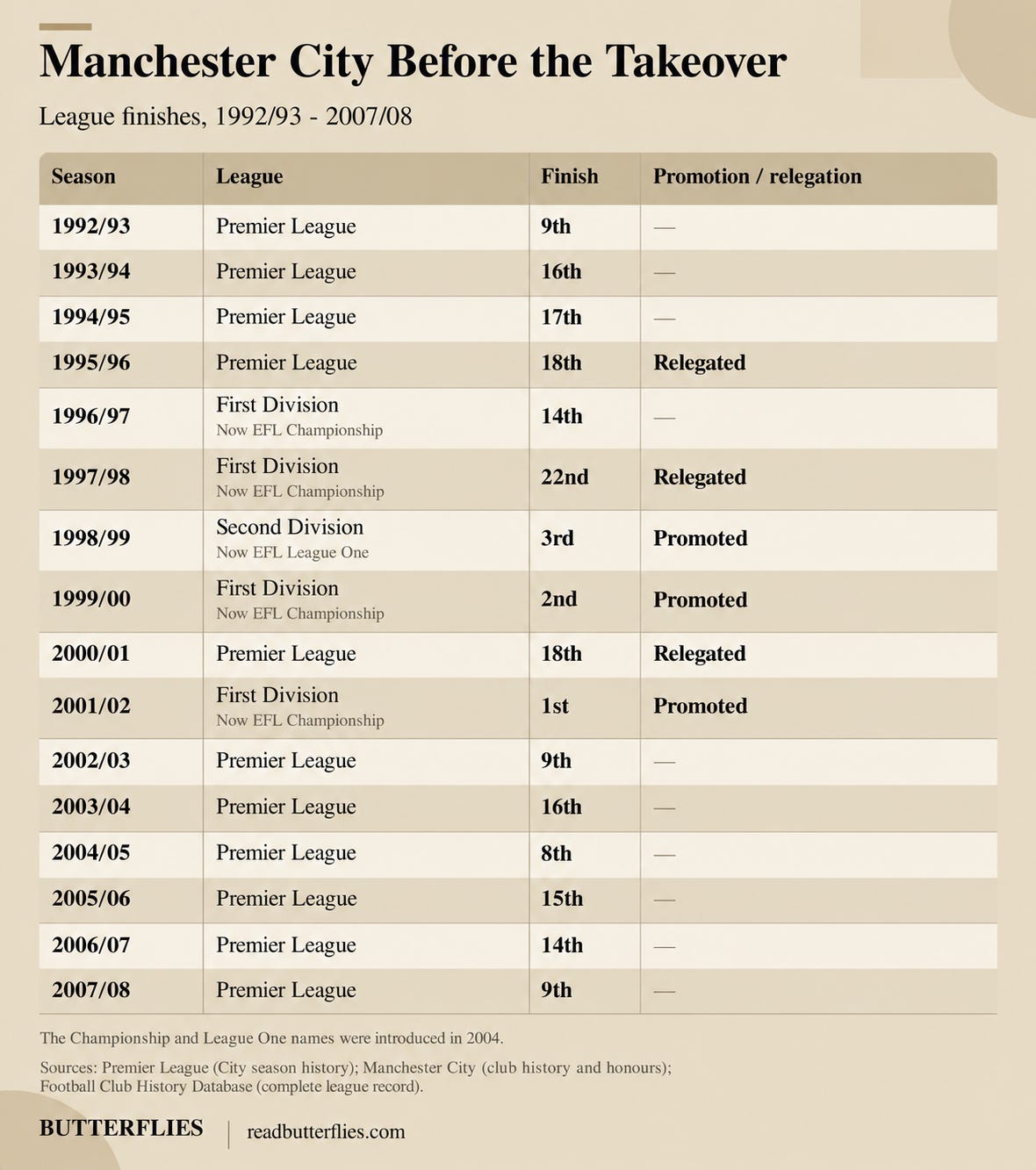
City wasn’t a perennial title contender when he arrived. In fact, City spent much of the 90s being relegated and promoted between the first and second division of English football, even spending a season in the third division.
However, since Sheikh Mansour arrived, City has won 26 trophies, including eight Premier League titles, four FA Cups, seven League Cups, and one Champions League. This is what his money bought the club and its fans.
All of City’s winning was called into question when the Premier League announced that an independent commission had found the club guilty of serious financial breaches spanning the 2009/10 through 2017/18 seasons.
According to the commission, Manchester City made sponsorship agreements appear larger than they were. Some sponsors paid only part of the reported sponsorship fees, with the owner supplying the rest and passing it off as revenue. The result was a club that appeared to meet financial rules when it had significantly exceeded the spending limits. City denied wrongdoing and appealed the findings.
There’s a detail in City’s history that makes this saga more interesting. Mansour bought the club when modern-day financial rules weren’t in play. I understand why the timing would be frustrating. He bought a club with enormous ambitions, and the rules governing how he could fund those ambitions changed. I’m sure he felt cheated out of his grand plans.
Prime Minister Andy Burnham expressed concern about the potential of losing City’s owners and praised their investment in Manchester. His comments drew criticism and some accused City’s owners of sportswashing.
Fines and points deductions are likely, but relegation, title removals, and straight bans are among the more severe potential outcomes. The consequences could be huge, not only for the club, but also for the surrounding area of Manchester.
But that shouldn’t influence the commission’s final ruling. If you cheat, you should be punished. And in the case of Manchester City, they should be punished harshly to show that rule-breaking isn’t tolerated. I want opposing fans to scream and chant more than they ever have when playing against City. I want each City away match to feel like a prison sentence.
Still, I can’t help but have a somewhat nuanced take on the whole thing. Not whether they should be punished, but whether the rules in place are even effective and accomplishing the right outcomes.
The Purpose of Financial Rules: Parity vs Protection
What are football’s financial rules actually supposed to accomplish?
In most American sports, salary caps ensure parity on the field. The NFL has a hard cap. The NBA’s system allows exceptions and uses a luxury tax, but both leagues have a uniform spending limit across the league. A team’s salary cap doesn’t simply rise because it sells more jerseys, tickets, and sponsorships than everyone else.
European football’s financial rules don’t ensure parity on the field. Instead, rules protect the club, its employees, and its creditors. The idea is that it ensures a billionaire’s willingness to spend today doesn’t leave the club in debt long after they are gone. Still, it is different from the NFL and NBA in that it actually prevents parity.
In American sports, an owner doesn’t have to overspend when they aren’t title contenders. The only consequence is a bad season and a high draft pick.
But for European football, lower-end teams are in a catch-22. They have to win enough to not get relegated. But they also can’t spend so much that they break financial rules. This dilemma for lower-half teams creates a disadvantage. And it’s a vicious cycle.
In the case of Manchester City, this is what happened. They were a mid-table team with an okay brand, but nothing that drew the popularity of a team like Manchester United. They were in the vicious cycle. So to get out of it, they cheated.
Football’s Elite Benefit The Most
That brings us to the “Red Cartel.”
It’s a derogatory label associated with Manchester United, Liverpool, and Arsenal. The argument is that these clubs built commercial reach with worldwide brand equity before the current rules existed, then benefited from a system that ties player spending to that reach.
As an Arsenal fan, I can understand why supporters of other clubs find that maddening. The established giants start with a substantial advantage, which showcases itself on the field. Just look at who won titles across Europe’s five biggest leagues over the last 10 seasons.
In Germany, Bayern Munich won nine of the last ten. In France, PSG won eight of the last ten. Italy had four different champions, but Juventus and Inter Milan combined to win seven of the last ten titles. In Spain, Barcelona won five, Real Madrid won four, and Atlético Madrid won one. Even in England, Manchester City won six of ten (though they were only able to because they cheated).
If you support a club outside that small group, how realistic is your hope of winning the league?
Contrast that with the NFL and NBA. Across those same ten years, the NFL has had six different champions and the NBA has had eight different champions. That’s a huge difference.
Now, financial rules alone don’t mean only a few clubs can win a title. Just look at Leicester City as a counterexample. However, the rules do make it that much harder for new clubs to break through and become perennial title challengers. Leicester was a one hit wonder and now down in the third tier of English football.
The Premier League says its rules aim to protect competitive balance as well as financial sustainability. But the current system hasn’t improved competitive balance. It only reinforces the Premier League hierarchy that has always been there. I’m not saying we should allow unlimited spending. But I am saying rules that tie squad building to existing revenue are too limiting and punishes clubs on the field that otherwise could be title contenders because of smart squad building.
Belief Is What Makes Fandom Fun
Manchester City fans didn’t cook the books. Local business owners didn’t lie about the sponsorship arrangements. Yet they both will feel the consequences of decisions made above them.
I’m not going to pretend I feel sorry for City’s leadership. But I do feel for the supporters and the city. And as a sports fan, I want competition. If we are upset about Manchester City’s cheating because it’s unfair, we also need to talk about the rules themselves being unfair.
I want Arsenal to win. I also want clubs outside the established giants to have a believable path toward winning. Financial rules should enable that belief for fans, not take it away.